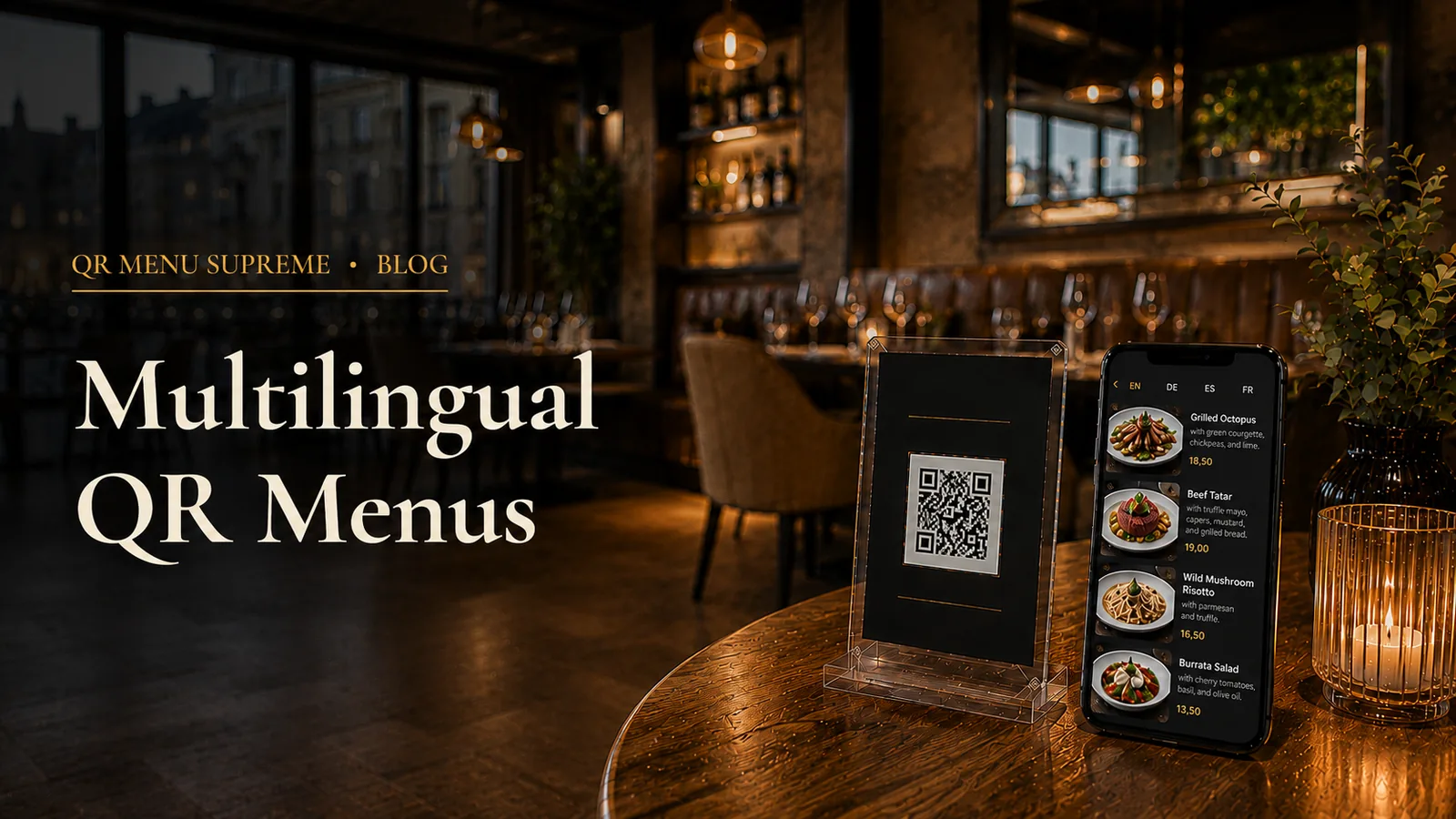
How Multilingual QR Menus Help Restaurants Serve More Tourists
Tourists Are a Restaurant's Most Valuable Guests. Most Restaurants Treat Them Like an Afterthought.
In the fine dining segment, an average of 41 percent of annual sales come from travelers and visitors. For some fine dining restaurants, that figure exceeds 60 percent. In the family dining, casual dining, and coffee-and-snack segments, roughly one third of all sales come from travelers and visitors.
Those are not small numbers. For many restaurants, tourists and visitors are not a secondary revenue stream. They are the business.
And yet the experience most restaurants offer an international tourist is identical to the one they offer a local: a printed menu in the local language, a server who may or may not speak English, and the implicit expectation that the guest will figure it out.
Some guests do figure it out. They point at something, guess at a description, or default to a dish they recognize by name. Others order less than they intended because the menu felt impenetrable. Some leave without ordering at all.
None of this is intentional. It is simply the result of building a restaurant experience for one audience and not adjusting when a different audience walks in. A multilingual QR menu is one of the most direct ways to fix that, and it does so without changing anything about the restaurant itself.
This article explains how multilingual QR menus work in practice, what restaurants actually gain from them, and how to think about which languages to offer.
The Scale of the Opportunity
An estimated 1.52 billion international tourists traveled globally in 2025, almost 60 million more than in 2024. In the first quarter of 2026 alone, 307 million tourists traveled internationally. International tourism receipts reached an estimated 1.9 trillion USD in 2025, representing a 5 to 6 percent increase from 2024 in real terms.
These guests eat in restaurants. The global culinary tourism market reached 1,248 billion USD in 2025 and is projected to grow to over 4,258 billion USD by 2034. Food is not a peripheral part of the travel experience for most international visitors. For a growing segment, it is the primary reason they chose a destination.
The top countries of origin for overseas arrivals to the United States in 2026 are projected to be the United Kingdom, Japan, Brazil, India, Germany, South Korea, China, and France. A restaurant in a tourist district that offers its menu only in English is already inaccessible to a significant share of those visitors. A restaurant in Germany or Austria that offers its menu only in German faces the same problem in reverse.
The guests are there. The spending is there. The barrier is a menu that speaks only one language.
What Happens When a Tourist Cannot Read the Menu
The consequences of a language-inaccessible menu are predictable and measurable, even if most restaurants have never quantified them.
Guests order less. When a guest cannot read dish descriptions, they default to what they recognize by name. A familiar pasta dish or a recognizable protein. They skip the specials, ignore the seasonal items, and rarely order appetizers or desserts that require understanding a description. The average check from a guest who could not fully read the menu is lower than it would have been.
Guests ask more questions. Every question about what a dish contains or how it is prepared is a task diverted from another table. In a busy service, a server who spends three minutes helping an international guest decode the menu is not serving other guests during that time. This is a real operational cost, even if it never appears in a spreadsheet.
Guests feel less welcome. This is harder to quantify but easier to observe. A guest who cannot understand what they are being offered has a fundamentally different experience than one who can browse freely, read what appeals to them, and make an informed choice. The second experience is more enjoyable, and enjoyable experiences generate reviews, recommendations, and return visits.
Guests leave worse reviews. Dissatisfaction that stems from confusion rarely gets attributed to the menu. It shows up as "service was slow" or "not what I expected" in reviews that a restaurant cannot effectively respond to, because the real cause was never named.
How a Multilingual QR Menu Changes This
A multilingual QR menu addresses all four consequences above without adding staff, changing the kitchen workflow, or reprinting anything.
Guests read the menu in their own language. The restaurant enters the menu once, in the language it operates in. On a first visit, the menu detects the device or browser language and opens in the matching available translation. If that language is unavailable, it falls back to the restaurant's working language. Guests can still switch manually at any time, and that choice is remembered for later visits. A phone set to Japanese sees Japanese, one set to Portuguese sees Portuguese, and one set to German sees German, without server involvement.
Average check size increases. When guests can read every item on the menu, including appetizers, specials, and desserts, they order from a fuller picture of what is available. A guest who understands what a dish actually contains is more likely to order it than one who has to guess. The data from restaurants that have switched to multilingual digital menus consistently shows higher average check sizes, particularly from international guests.
Staff spend less time explaining the menu. A server who does not need to read the menu aloud to a non-English-speaking table has more time for the table management and hospitality that improves the experience for every guest in the room. The operational benefit compounds across a full service.
Guests feel genuinely welcomed. There is a meaningful difference between being tolerated as a guest and being anticipated as one. A restaurant that has thought about the language its international guests speak is a restaurant that considered those guests when setting up the experience. That is felt, even when it is not explicitly noticed.
Which Languages to Offer and How to Decide
The answer depends entirely on where the restaurant is and who walks through the door.
A restaurant in a beach resort town in southern Spain will have different priorities than a restaurant near a convention center in Frankfurt or a café in central Tokyo. The right languages are the ones your guests actually speak, not the ones that seem obvious in the abstract.
A practical approach:
Start with your existing guest data. If you collect email addresses or take reservations, look at the country codes in your booking data. If you use a digital menu already, check whether the platform shows you which language guests use, whether detected automatically or chosen manually. That data tells you who is actually ordering.
Ask your staff. The servers and hosts who interact with guests daily know which languages come up most often. A quick conversation at the start of a week will surface patterns that no analytics dashboard shows.
Look at local tourism data. Most cities and regions publish data on where their inbound tourists come from. For a restaurant in a tourist district, that data is a reasonable proxy for who will walk in. The top five or six origin countries are almost always enough to cover the majority of international guests.
Do not try to cover every language immediately. A menu available in four languages, done properly, is more useful than a menu available in twenty languages that were machine-translated and never reviewed. Start with the languages that correspond to your highest-volume international guests and add others as patterns emerge.
A Practical Note on Translation Quality
There are two ways to make a menu multilingual: machine translation and human translation.
Machine translation has improved considerably and is adequate for basic item names and simple descriptions. It is fast and essentially free. For most restaurants, it is a reasonable starting point.
Where machine translation struggles is with menu descriptions that rely on cultural context, local ingredient names, or deliberately evocative language. A dish described as "slow-braised in our grandmother's secret recipe" may translate literally but lose its meaning entirely in another language. A dish name that is a regional term with no direct equivalent in English or Japanese needs a human decision about how to handle it.
The practical approach for most restaurants: use machine translation as the baseline, then review the translations for your highest-volume language with a native speaker, even informally. A staff member, a regular guest, or a brief paid review is enough to catch the errors that matter most.
Comparison: What Changes With a Multilingual QR Menu
| Single-language printed menu | Multilingual QR menu | |
|---|---|---|
| International guest can read fully | No | Yes |
| Staff time spent explaining menu | High | Low |
| Average check from international guests | Lower | Higher |
| Guest feels genuinely welcomed | Partial | Yes |
| Cost to add a new language | Reprint required | Minutes to update |
| Cost to update a translated item | Reprint required | Free, immediate |
| Number of languages possible | 1 per print run | Up to 56 |
| Language on first open | Printed language only | Device/browser language when available |
| Manual language switch | No | Yes |
Frequently Asked Questions
How many languages does a restaurant actually need?
For most restaurants in tourist areas, three to five languages cover the large majority of international guests. The specific languages depend on where the guests come from, which varies by city, region, and type of establishment. A restaurant near a convention center needs different languages than one in a beach resort. Start with the top two or three languages represented in your international guest mix and add others as the pattern becomes clearer.
Do guests need to choose their language manually?
Usually not. When a translation is available, the menu opens automatically in the language detected from the guest's device or browser. If that language is not among the restaurant's available translations, the menu falls back to the restaurant's working language. Guests can still switch manually from the menu whenever they prefer another option.
Does a multilingual menu affect how the kitchen operates?
Not at all. The kitchen receives the same order information regardless of which language was detected or selected for the guest. The menu language affects only what the guest sees on their phone. Nothing changes in the back of house.
What if we make mistakes in the translation?
Mistakes in a digital menu can be corrected in minutes. Unlike a printed menu, where an error costs a reprint, a correction to a digital translation takes less time than it took to discover the mistake. The low cost of fixing errors is one of the practical advantages of a digital multilingual menu over a printed one.
Is a multilingual menu worth the effort for a restaurant that sees only occasional international guests?
The question is less about the frequency of international guests and more about the value of the interaction when they do come. An occasional international guest who has a good experience because they could read the menu in their language is more likely to leave a review, recommend the restaurant, and return on a future visit than one who had a frustrating experience and blamed themselves for not knowing the language. The return on the effort is asymmetric: the cost of adding a language is low, and the benefit of a single positive international guest interaction compounds over time.
Conclusion
Travelers and visitors account for roughly one third of sales in the casual dining and coffee-and-snack segments, and for 1 in 4 dollars spent in quickservice and fast casual. That revenue is at risk every time an international guest looks at a menu they cannot fully understand and orders less than they intended.
A multilingual QR menu does not require new staff, a larger kitchen, or a change in what the restaurant serves. It requires entering the menu once, selecting which languages to make available, and placing a QR code on the table. On a first visit, the menu detects the guest's device or browser language automatically. The manual selector remains available, and the guest's choice is remembered for later visits.
The practical gain is a guest who can browse the full menu, understand every item, and make a genuine choice rather than a guess. That guest orders more, asks fewer questions of staff, and leaves with a better experience than they would have had otherwise.
QR Menu Supreme supports up to 56 languages on the guest-facing menu, with the restaurant choosing which languages to make available. The menu is entered once in the restaurant's working language. Translation is handled by the platform. On a first visit, the guest's device or browser language is detected automatically; if it is unavailable, the restaurant's working language is shown. Guests can change the language manually, and that choice is remembered for later visits. Updates to any language version happen in the same step as the original update, with no additional work.
The tourists are coming. Europe alone welcomed over 130 million international tourists in the first quarter of 2026, a 4 percent increase on the same period the year before. The restaurants that have already made their menus readable in those guests' languages will get the order. The ones that have not will get a question they may not be able to answer.
See a live QR menu in 10 seconds
Browse the showcase demo restaurant, built with QR Menu Supreme.