Online Ordering Without Platform Commissions: Keep More of Every Order
The Percentage That Looks Small Until It Is Not
Restaurant owners are used to working with narrow margins. Food costs, labor, rent, utilities, taxes, packaging, payment processing, and delivery all take their share before the restaurant sees a profit.
That is why a commission on every online order deserves careful attention.
A platform that charges 10, 15, or 30 percent of every sale may be convenient at first. But the cost grows with every successful order. The more the restaurant sells, the more it gives away.
For a restaurant processing $10,000 per month through an ordering system, a 15 percent platform commission equals $1,500 per month. Over a year, that is $18,000 before payment-processing fees, subscriptions, or delivery costs.
Commission-free ordering works differently. Instead of taking a percentage of each order, the platform charges a fixed subscription, offers a free plan, or charges only for optional services. The restaurant keeps the revenue from the order, apart from unavoidable costs such as card-processing fees and taxes.
This distinction matters. "No commission" does not mean "no fees." It means the ordering platform is not taking an additional percentage of every transaction.
This guide explains how commission-free online ordering works, what costs still apply, which types of platforms offer it, and how restaurants can choose a model that protects their margins.
What "No Commission" Actually Means
Before comparing platforms, it helps to separate three costs that are often grouped together.
Platform commission. This is a percentage charged by the ordering platform for every order processed through its system. It may apply to online ordering, QR ordering, delivery orders, or all three.
Payment-processing fees. Card payments require a processor such as Stripe, Square, or another payment provider. The processor charges a fee for securely handling the transaction. This is separate from a platform commission.
Monthly subscription. Some platforms charge a fixed monthly price for access to menu management, ordering, payment features, analytics, branding, or multi-location tools.
A commission-free platform normally means:
- No percentage charged by the platform on each order
- A fixed monthly cost, free plan, or feature-based subscription instead
- Payment-processing fees may still apply
- Restaurants keep control of their direct ordering revenue
That is usually easier to budget for than a variable percentage that rises with sales.
Why Commission-Based Ordering Gets Expensive
Commission-based services can be useful when they bring a restaurant new customers through a large marketplace. The problem begins when the same commission applies to customers the restaurant already earned through its own website, social media, Google Business Profile, or QR code at the table.
If a regular guest scans a QR code in the restaurant and places an order, there is little reason for the restaurant to lose a large percentage of that sale to an intermediary.
Consider a simple example:
| Monthly online order revenue | 10% commission | 15% commission | 25% commission |
|---|---|---|---|
| $5,000 | $500 | $750 | $1,250 |
| $10,000 | $1,000 | $1,500 | $2,500 |
| $20,000 | $2,000 | $3,000 | $5,000 |
A fixed monthly subscription may cost more at very low order volume. But once direct ordering becomes a meaningful part of the business, a no-commission model is often more predictable and more profitable.
The important question is not simply, "Is this platform free?" It is: What will this platform cost when my ordering volume grows?
Types of Commission-Free Ordering Platforms
Not every commission-free option works the same way. Restaurants should choose based on their service model, existing POS system, and whether they need ordering at the table, pickup, delivery, or all three.
1. QR Menu and Table-Ordering Platforms
QR ordering platforms let guests scan a code at the table, browse the menu, place an order, and in some cases pay from their phone.
These platforms are often well suited to restaurants, cafés, bars, and hotel venues where guests are already on site. The restaurant does not need a third-party marketplace to acquire the customer because the customer is already sitting at the table.
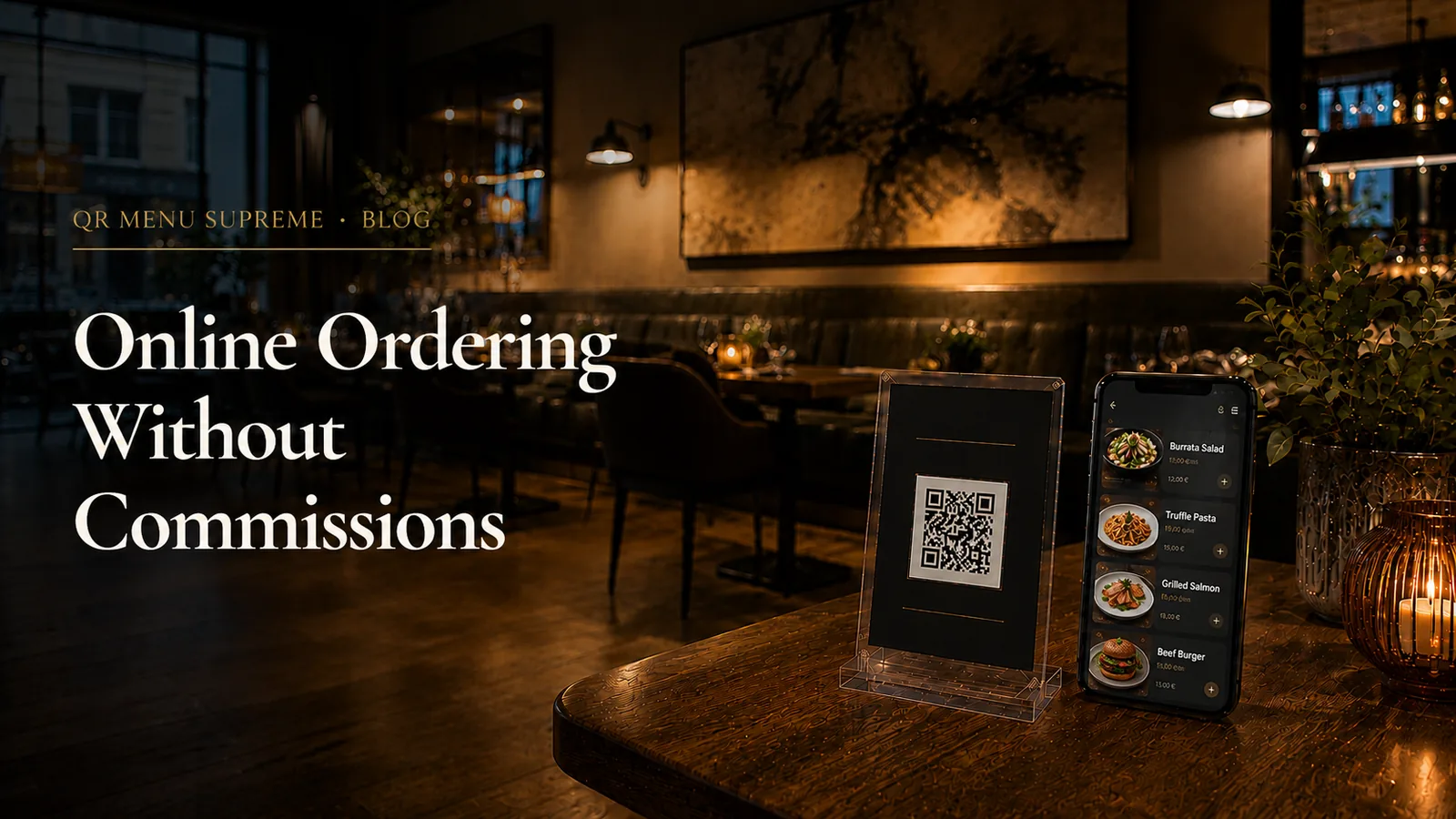
QR Menu Supreme follows this model. Restaurants can begin with a digital QR menu, then activate table ordering and payment when they are ready. The platform does not take a commission on orders. Restaurants pay for the plan they choose and any applicable payment-processing fees.
Best for:
- Restaurants with dine-in service
- Bars and cafés with frequently changing menus
- Businesses that want to add ordering without replacing their entire POS
- Restaurants serving international guests who need multilingual menus
2. POS-Integrated Ordering Systems
Some point-of-sale providers include online ordering or QR ordering as part of a broader payment and operations system.
This can be a practical option for restaurants already using that POS. The ordering flow, payment reporting, menu data, and kitchen operations may all stay inside one ecosystem.
However, restaurants should check the full cost carefully. A provider may not charge a platform commission, but its payment-processing fees, hardware requirements, or higher-tier subscriptions may still affect the total cost.
Best for:
- Restaurants already committed to a particular POS provider
- Businesses that want fewer separate systems
- Operators who value unified reporting and payment reconciliation
3. Direct Online Ordering Platforms
Direct ordering platforms help restaurants accept pickup, delivery, or preorder sales through their own website rather than through a marketplace.
The customer orders directly from the restaurant's brand, not from a marketplace app that controls the relationship. This can reduce commission costs and help the restaurant retain customer data, subject to applicable privacy rules.
The trade-off is visibility. A marketplace may bring discovery traffic, while a direct ordering platform usually depends on the restaurant's own marketing, website, Google presence, and repeat customers.
Best for:
- Restaurants with an established customer base
- Brands that already receive website, social, or Google traffic
- Businesses that want to own their customer relationship
What to Check Before Choosing a Commission-Free Platform
A "no commission" label is not enough on its own. These questions reveal the real cost and practical value of the platform.
Is There Really No Platform Percentage?
Read the pricing page and terms carefully. Confirm whether the platform takes a percentage from:
- Table orders
- Pickup orders
- Delivery orders
- Payments processed through the platform
- Orders above a monthly threshold
A provider may advertise no commission for one order type while charging fees for another.
What Payment-Processing Fees Apply?
Payment-processing fees are normal. They pay for card networks, fraud prevention, payment security, and settlement.
Ask which processor is used, whether you can connect your own account, and whether the platform adds any markup to the processor's standard rate.
What Does the Monthly Plan Include?
A low entry price can become expensive when essential features are locked behind upgrades. Check whether your plan includes:
- Unlimited or sufficient menu items
- Table ordering
- Integrated payment
- QR code generation
- Multiple locations or menus
- Branding options
- Analytics
- Language support
- Customer support
Can You Start Small and Expand Later?
The best system for many restaurants is not necessarily the most feature-rich system on day one. It is the one that lets the restaurant start with a simple digital menu and add ordering, payment, or more locations when the business is ready.
Does It Work Well on a Guest's Phone?
A commission-free platform still fails if guests cannot use it easily.
Test the actual guest experience on iPhone and Android. Check loading speed, menu readability, whether the menu detects the device or browser language automatically on a first visit, whether it falls back to the restaurant's working language when that translation is unavailable, whether guests can switch language manually, whether a later visit remembers that choice, the ordering and payment flows, and whether the QR code works under real restaurant lighting.
Comparison: Commission Model vs Fixed-Cost Model
| Feature | Commission-Based Marketplace | Commission-Free Direct Ordering |
|---|---|---|
| Platform cost | Percentage of every order | Usually fixed monthly plan or free tier |
| Cost as sales grow | Increases with every order | More predictable |
| Customer relationship | Often controlled by marketplace | Primarily owned by restaurant |
| Marketplace discovery | Often included | Usually depends on restaurant marketing |
| QR ordering at tables | Varies | Often a core feature |
| Payment-processing fees | Usually still apply | Usually still apply |
| Brand control | Often limited | Usually stronger |
| Best use case | Customer acquisition through marketplace | Direct orders and repeat customers |
Neither model is automatically wrong. A marketplace may be worth the commission when it brings customers who would not otherwise find the restaurant. For direct traffic and in-house QR orders, a commission-free system is usually the more logical model.
A Practical Setup for Restaurants That Want More Control
For many independent restaurants, the strongest approach is not to abandon every marketplace immediately. It is to separate customer acquisition from direct ordering.
A restaurant can use marketplaces selectively for discovery while building its own direct ordering channel for repeat guests.
A practical structure looks like this:
- Use a QR menu at tables for dine-in guests.
- Add direct ordering through the restaurant website or social profiles.
- Encourage returning guests to order directly.
- Keep marketplace use for discovery where it makes economic sense.
- Review commission spending every month.
This gives the restaurant more control over margins without depending entirely on one source of orders.
Frequently Asked Questions
Does commission-free ordering mean I keep 100 percent of every sale?
Not exactly. You keep 100 percent of the order value from the platform-commission perspective, but card-processing fees, taxes, refunds, and other operating costs may still apply. The key difference is that the ordering platform does not take an additional percentage of every order.
Are monthly subscriptions always cheaper than commissions?
Not at very low volume. A free or commission-based option may cost less when a restaurant receives only a few direct orders each month. As direct order volume grows, a predictable fixed monthly cost often becomes more economical.
Can I accept payments without paying any fees?
Card payments almost always involve processing fees. A restaurant may avoid platform commissions, but payment processors still charge for handling the transaction securely.
Should I stop using delivery marketplaces?
Not necessarily. Marketplaces can help restaurants reach new customers. The better question is whether the same commission should apply to customers who already know the restaurant and could order directly.
Can QR ordering work without replacing staff?
Yes. Many restaurants begin with a display-only QR menu. Guests still order through staff. Later, the restaurant can enable table ordering or payment if it improves the service model.
Conclusion
Online ordering should help restaurants protect their margins, not quietly erode them.
A commission-free platform gives restaurants a more predictable cost structure, especially for direct orders and QR orders from guests already sitting at the table. The restaurant pays for the tools it uses instead of giving away a percentage of every successful sale.
The right choice depends on the restaurant's setup. A marketplace may still make sense for discovery. But for direct customers, repeat guests, and table ordering, a no-commission platform can make the economics much clearer.
QR Menu Supreme offers a free plan for restaurants that want to build a digital menu first and evaluate the experience before committing. When ordering is enabled, the platform supports commission-free table ordering and integrated payment within the same system.
See a live QR menu in 10 seconds
Browse the showcase demo restaurant, built with QR Menu Supreme.