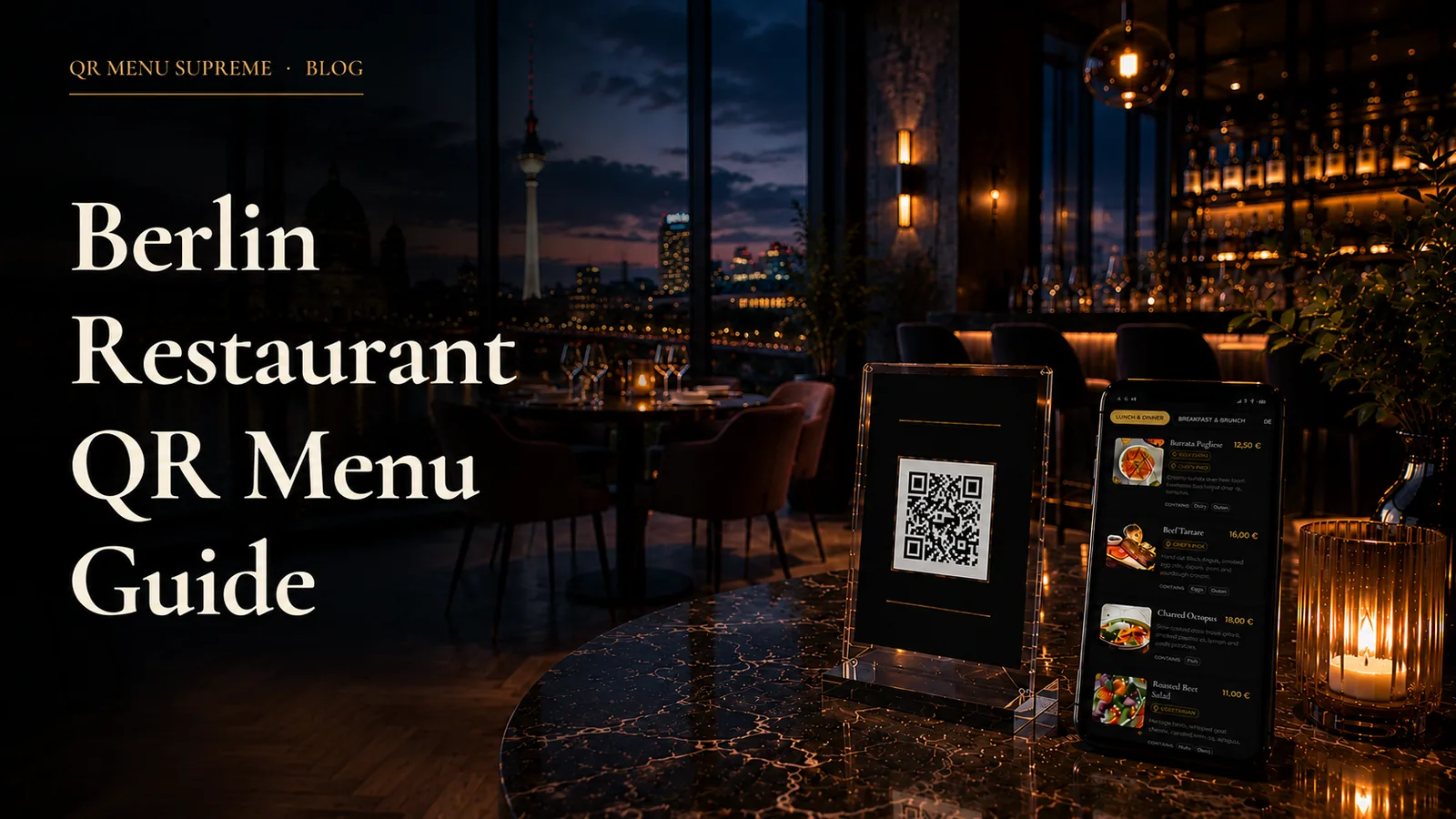
QR Menu for Restaurants in Berlin: What to Use and How to Set It Up
Berlin has over 10,000 restaurants, cafés, and bars. Here is what to look for in QR menu software for the Berlin market in 2026, and how to get started.
Berlin Has One of the Most Competitive Restaurant Scenes in Europe
With over 10,000 restaurants, cafés, and culinary businesses, Berlin is not just Germany's most populous city, it is one of the country's most concentrated hubs for hospitality. The density of restaurants in Berlin is higher than in any other German city, at 4.2 per 1,000 inhabitants.
That density creates two things simultaneously: opportunity and pressure. The opportunity is obvious. Berlin draws millions of tourists annually, has a large international resident population, and a dining culture that spans everything from neighborhood Imbiss counters to Michelin-starred kitchens. The pressure is equally real. Margins are tight across the German hospitality sector, staff costs are rising, and guests in 2026 arrive with expectations shaped by the best digital experiences they have encountered anywhere in the world.
One of those expectations, increasingly standard across European cities, is a QR code on the table. QR menus have become standard across Europe's restaurant industry, with Western Europe, including Germany, sitting at 55 to 65 percent adoption among full-service restaurants. Berlin, as Germany's most internationally oriented city, tends to lead rather than follow that average.
For Berlin restaurant owners who are still using printed menus exclusively, or who are using a basic QR tool that only displays a PDF, this article explains what a modern QR menu system actually does, what to look for in a platform that fits the Berlin market specifically, and how to get one set up without a technical team or a large budget.
What Berlin Restaurants Actually Need From a QR Menu Platform
Not every QR menu platform is built with the Berlin market in mind. A tool designed for a single-language domestic market in a smaller city will struggle with the realities of running a restaurant in a city where your guests on any given evening might speak German, English, Turkish, Arabic, French, or Italian.
Here is what matters specifically for Berlin:
Multilingual menu display. Berlin's guest mix is unlike most German cities. A tourist district like Mitte or a neighborhood like Prenzlauer Berg draws international visitors alongside locals. A QR menu that only displays in German may leave a meaningful share of the room underserved. A platform that opens the menu automatically in the guest's device or browser language on a first visit when a matching translation is available, while still allowing a saved manual switch to any of 56 available languages, covers the full range of a Berlin dining room without any additional effort from staff.
GDPR compliance. Any software that collects guest data, even basic analytics like scan counts, must comply with the General Data Protection Regulation. For restaurants operating in Germany and the EU, this is not optional. A platform that is GDPR-compliant removes legal risk from the operator. Running a tool that is not compliant, even unknowingly, creates exposure that a restaurant owner should not have to think about.
Real-time updates. Berlin's restaurant scene is fast-moving. Seasonal menus, daily specials, ingredient availability, and price adjustments need to be reflected immediately. A platform that requires reprinting or a multi-step republishing process to update the menu is not suited to an operation that changes its offering regularly.
No per-order commission. The German hospitality sector has been under significant margin pressure since the VAT increase on restaurant meals. A platform that takes a percentage of every order adds a recurring cost that compounds with volume. For a Berlin restaurant doing meaningful order volume through a digital menu, a flat monthly subscription with no commission is a substantially better financial structure.
A dashboard that works in German. Many restaurant owners and managers in Berlin operate primarily in German. A platform whose dashboard only works in English creates friction in daily management. A system that adapts the dashboard language to the user's browser setting removes that friction entirely.
What to Look for When Choosing a QR Menu Platform for Your Berlin Restaurant
The criteria below are the practical checklist for any Berlin restaurant evaluating QR menu software in 2026:
- Automatic language detection with a manual override. On a first visit, the menu should open in the guest's device or browser language when that translation is available, fall back to the restaurant's primary language when it is not, and let guests switch manually from within the menu. A later visit should remember that choice. This is particularly important for restaurants in tourist-heavy neighborhoods like Mitte, Friedrichshain, and Charlottenburg.
- GDPR and DSGVO compliance. The platform should be explicitly GDPR-compliant. Check the platform's data processing terms before signing up.
- Dashboard language flexibility. The management interface should adapt to the user's language, not require staff to manage a menu in a language they don't work in day to day.
- Real-time menu editing from any device. Menu changes should be live immediately. The ability to update from a phone during service, without logging into a desktop system, is a meaningful practical advantage in a busy operation.
- Table ordering capability when you need it. A platform that starts as a display tool and can be expanded to table ordering later, without switching providers, gives a restaurant room to grow without the disruption of a migration.
- Integrated payment. For restaurants that want to enable table-side payment, the payment flow should happen within the same interface. Sending guests to a separate payment app or external processor creates friction that reduces completion rates.
- Free entry point. Given the cost pressures in the Berlin market, a free plan that allows a restaurant to test the full setup before committing to a subscription is a meaningful practical advantage.
How QR Menu Supreme Fits the Berlin Market
QR Menu Supreme is built around the combination of digital menu display, table ordering, and integrated payment. For Berlin specifically, several aspects of the platform address the requirements above directly.
Multilingual display, detected automatically. On a first visit, QR Menu Supreme detects the guest's device or browser language and shows the matching available translation. If that language is unavailable, it falls back to the restaurant's primary language. Guests can still switch manually to any of 56 available languages from the menu interface, and that choice is remembered for later visits. A phone set to German sees German, one set to English sees English, and one set to French sees French. The restaurant does not need to create or maintain separate language versions of the menu.
Dashboard in 56 languages. The management dashboard also adapts automatically to the browser language of the person logged in. A German-speaking manager sees the interface in German. A staff member who speaks another language sees it in their language. This is not a translation toggle that needs to be set manually; it works from the browser setting.
GDPR and DSGVO compliant. QR Menu Supreme meets GDPR requirements, which means Berlin restaurants can use the platform without taking on data protection risk.
No commission on orders. Pricing is subscription-based. There is no percentage taken from each order, which keeps the cost structure predictable regardless of how many orders come through the digital menu.
Free plan available. Restaurants that want to test the platform before committing can start on the free plan, build their full menu, generate a QR code, and see how guests respond, before deciding whether to move to a paid plan.
Expandable to table ordering and payment. Restaurants that start with display-only can enable ordering and payment later within the same platform, with per-table QR codes assigned when ordering is activated.
The German-language landing page for QR Menu Supreme is available for Berlin operators who prefer to evaluate the platform in German.
Setting Up a QR Menu for Your Berlin Restaurant: A Practical Overview
The process is the same regardless of city, but a few Berlin-specific considerations are worth noting.
Step 1: Decide what the menu needs to do. For most Berlin restaurants, the multilingual display is the first priority. Decide whether you want to start with display-only or enable ordering from day one.
Step 2: Prepare your menu content in your primary language. The platform handles display in other languages automatically. You enter the menu in the language you work in, and the guest-facing interface handles the rest.
Step 3: Set up the platform and build the menu. For a standard restaurant menu without photos, this takes two to three hours. With photos, allow an additional hour or two. Use real photos where possible: in a competitive market like Berlin, menu photography directly affects order decisions.
Step 4: Generate and test the QR code. Test on multiple devices, including both iOS and Android, and under the actual lighting conditions of your dining room. A QR code that scans easily in a brightly lit office may perform differently in a dimly lit dinner setting.
Step 5: Place the QR code at the table. Table tents are the most practical format for most Berlin restaurants. For higher-end settings, acrylic stands are a clean alternative. Include a brief instruction line in German and English. One short sentence in each language is enough.
Step 6: Brief your team. In a multilingual operation, staff should know what the QR menu does and how to help a guest who has a question about it. The briefing takes 10 minutes and avoids confusion during service.
Comparison: Key Features for Berlin Restaurants
| Feature | Relevant for Berlin | QR Menu Supreme |
|---|---|---|
| Automatic language detection + manual switch | High priority | ✅ Yes, 56 languages |
| Dashboard in German | Practical necessity | ✅ Yes, 56 languages |
| GDPR / DSGVO compliant | Required | ✅ Yes |
| Real-time menu updates | High priority | ✅ Yes |
| Table ordering capability | Optional, growing demand | ✅ Yes |
| Integrated payment | Optional, growing demand | ✅ Yes |
| No commission on orders | Important for margins | ✅ Yes |
| Free plan to start | Useful for evaluation | ✅ Yes |
Frequently Asked Questions
Do Berlin restaurants need a QR menu in 2026?
Not legally, but practically it has become close to a baseline expectation in most parts of the city, particularly in neighborhoods with high tourist traffic or a younger guest demographic. Restaurants without a digital menu option are increasingly the exception rather than the norm.
What language should a QR menu be in for a Berlin restaurant?
Ideally, both German and English as a minimum. A platform that handles language display automatically based on the guest's phone setting is more practical than maintaining separate language versions manually, especially in a city with as diverse a guest mix as Berlin.
Is a QR menu GDPR-compliant?
It depends entirely on the platform. Some tools collect guest data in ways that require explicit consent under GDPR. Others are built to be compliant by default. QR Menu Supreme is GDPR-compliant, which removes this concern for Berlin operators.
Can I use a QR menu alongside a German-language printed menu?
Yes, and for many Berlin restaurants this is the practical starting point. The printed menu serves guests who prefer it. The QR menu serves international guests and guests who want more detail, photos, or a different language. Running both simultaneously requires no technical changes to either format.
How much does a QR menu cost for a Berlin restaurant?
The free plan on QR Menu Supreme covers the basic setup at no cost. Paid plans start at $19 per month. There are no commissions on orders. For a restaurant that currently reprints menus several times a year, the switch typically saves money within the first few months.
Conclusion
Berlin's restaurant market in 2026 is demanding: dense competition, international guests, tight margins, and guests who arrive with high expectations for the quality of every part of their experience, including the menu.
A QR menu platform that is multilingual by default, GDPR-compliant, easy to manage in German, and expandable from display to ordering to payment as the restaurant grows, addresses those demands directly.
By 2026, a digital menu is no longer a nice-to-have. It is the first impression a restaurant makes. In a city with over 10,000 competitors, that first impression matters.
For Berlin restaurant owners who want to evaluate QR Menu Supreme in German, the German-language page is available with full details on plans, features, and setup. For those who want to start immediately, the free plan is available without a credit card and without a time limit.
See a live QR menu in 10 seconds
Browse the showcase demo restaurant — built with QR Menu Supreme.