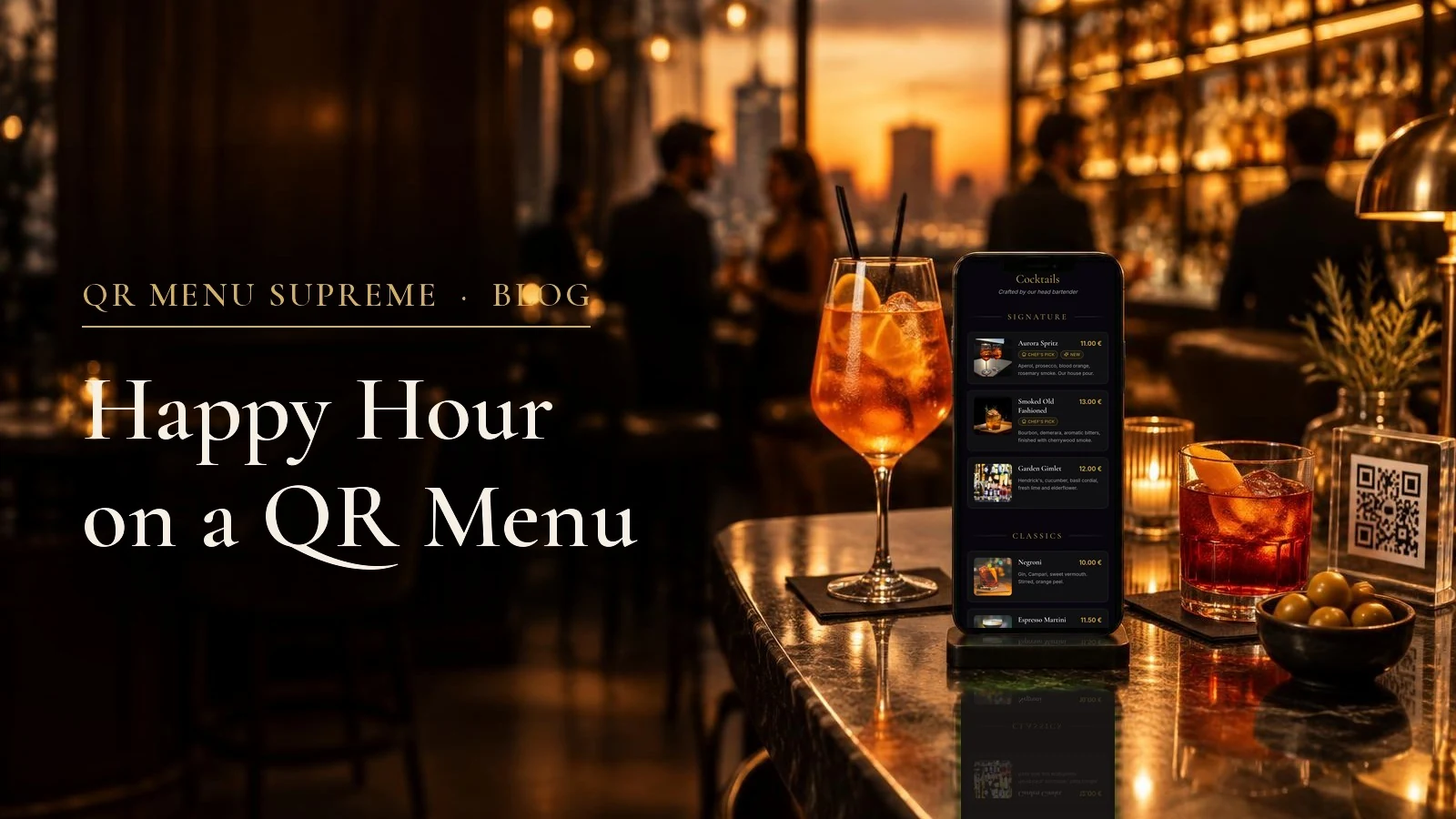
Happy Hour on a QR Menu: Prices That Switch at 5 pm on Their Own
At 7:20 pm, the menu still said $8
Thursday, 7:20 pm. Happy hour at the bar ran from 5 to 7. A table of four sits down and scans the code on the table tent. The house margarita is on the menu for $8, the happy hour price. Nobody changed it back. They order four.
The bartender rings them up at $12 each, the regular price. The table holds up a phone. The manager has two choices: charge $48 and argue, or charge $32 and swallow the difference. She swallows it. The person who was meant to change the price at 7 was pouring a round when the clock turned.
The discount was not the problem. The minute it ended was. A paper sign cannot end on time. A person can forget. A menu with a clock does not.
This guide is about running happy hour so that it makes money and ends when it says it ends. It covers:
- which hours and which drinks to choose,
- how much more you need to sell to break even,
- the rules that limit drink promotions in the US and the UK,
- what guests should see on the menu, and
- how QR Menu Supreme switches prices at the start and end of the window by itself.
It is an operating guide, not legal advice.
The short version: run happy hour in hours that would otherwise be quiet. Discount a few items that cost you little to serve. Work out how many more you must sell before you set the price. Check the rules where you trade, because in some places a timed drink discount is not allowed at all. Then let the menu change the price at the right minute, and give your till the same times.
What happy hour is for
Happy hour has one job: to fill seats in hours that would otherwise be empty. For most bars and restaurants, that means late afternoon on weekdays, after work and before dinner.
It works when it brings guests who would not have come. It also works when those guests stay: they order a second round, they order food, or they keep the table for dinner. It does not work in hours when you are already busy. A discount at 8 pm on a Friday gives the same guests the same drinks for less money.
| Hour | Usually | Happy hour makes sense? |
|---|---|---|
| Weekdays, 4 to 7 pm | Quiet before dinner | Yes, this is the classic window |
| Friday and Saturday, 7 to 10 pm | Full without help | No, you would discount demand you already have |
| Late night, after the kitchen closes | Quiet in many bars | Sometimes, if the bar stays open and the rules allow it |
| Lunch on a weekday | Depends on the area | Only for food and soft drinks in most places |
Before you set a single price, answer two questions. Which hours are empty now? And who could fill them: an office crowd, a theater crowd, students, neighbors? The answer decides the days, the times and the items.
The math: how many more drinks a discount needs
Every discount has a break-even point. Below it, happy hour costs you money. Above it, it pays.
Start with the margin: the price of a drink minus the cost of what goes into the glass. Labor and rent stay the same whether you sell the drink at full price or at happy hour, so leave them out for this comparison. Sales tax or VAT is left out too, so use prices without tax.
Then use one formula:
Extra sales needed = (margin at the regular price ÷ margin at the happy hour price) − 1
Here is what that looks like with example numbers:
| Item | Regular price | Happy hour price | Cost per serving | Margin, regular | Margin, happy hour | Sales needed to earn the same |
|---|---|---|---|---|---|---|
| Draft lager, pint | 7.00 | 5.00 | 1.60 | 5.40 | 3.40 | 59% more |
| House margarita | 12.00 | 8.00 | 2.80 | 9.20 | 5.20 | 77% more |
| Fries | 8.00 | 5.00 | 1.20 | 6.80 | 3.80 | 79% more |
Two things stand out. First, a discount that looks small on the price can be large on the margin. Taking $2 off a $7 pint removes more than a third of what the pint leaves you. Second, volume alone rarely pays for a happy hour. You need about 59 percent more pints just to stand still.
So count the whole window, not the discounted drinks. What matters is the total margin between 5 and 7 pm, plus the hour after, compared with the same weeks before. If the window fills seats that were empty and some of those guests order food or stay past 7 at full price, the offer pays. If the same regulars simply arrive earlier and pay less, it does not.
Which items to put on happy hour
A good happy hour list is short. Four to eight items is enough for most bars.
Choose items that cost little per serving. Draft beer, house wine by the glass and one or two house cocktails with a simple build. Their margin survives a discount better than a premium spirit does.
Choose items that are fast to make. At 5 pm the bar gets busy all at once. A cocktail with seven steps slows the whole room. A pint does not.
Add one or two cheap, quick dishes. Fries, a flatbread, a bowl of something. Food keeps guests at the table, and a table that stays is the guest who might order dinner at full price.
Leave out your best sellers at full price. If the house red already sells all evening at $11, a happy hour price on it gives away margin on drinks guests would buy anyway.
Say exactly what the guest gets. Size and price: "Draft lager, pint" or "House red, 150 ml". The guide to writing menu descriptions that sell shows how to describe a drink in one line without empty words like "refreshing".
Decide where happy hour applies. Many bars run it only at the bar counter. A QR menu cannot tell a bar stool from a table. If the menu shows the happy hour price, every guest who scans it will see it. The simple answer is to run happy hour for the whole room, or to keep it off the QR menu.
Check the rules where you trade
Happy hour is a price promotion on alcohol, and alcohol is regulated locally. A few examples show how far apart the rules can be.
| Where | What the rule says | What it means for a timed drink discount |
|---|---|---|
| Massachusetts | The state has banned happy hour since 1984. Its alcohol regulator reminds licensees every year that they may not sell a drink for less than they charge for it during the same week, or sell an open bar for a fixed price except at private functions | Not allowed. In 2026, lawmakers debated letting cities and towns decide for themselves. At the time of writing, the ban was still in force |
| Other US states | Rules differ by state and sometimes by city | Check with your state alcohol agency before you plan an offer |
| England and Wales | Mandatory license conditions ban irresponsible promotions, such as offers that push people to drink more than they would. Since 28 May 2014, alcohol may not be sold below the cost of duty plus VAT | Allowed, if the offer is not irresponsible and every price stays at or above duty plus VAT |
| Scotland | A price change for alcohol may only start at the beginning of licensed hours. After that, no alcohol price on the premises may change again for 72 hours | A drink discount from 5 to 7 pm is not possible. Use the window for food and soft drinks only |
| Scotland and Wales | A minimum price per unit of alcohol applies | No happy hour price may go below the minimum |
One rule applies almost everywhere: you may not serve someone who is drunk. In England and Wales, knowingly selling alcohol to a person who is drunk is an offense under section 141 of the Licensing Act 2003. Most US states have rules against serving visibly intoxicated guests. A happy hour does not change that, and staff should know it before the first busy Thursday.
The guide to QR menus for bars and pubs makes the same point from the other side: the menu should follow the license you already trade under. It should not invent a promotion the license does not allow.
What the guest should see
A happy hour that guests misunderstand costs as much as one that ends late. Four things keep it clear.
The price and its end time, on the item. Not a banner at the top of the menu that the guest scrolls past. The guest should see "$8" and the time the offer ends in the same place as the drink.
One price at a time. Showing "Regular $12, happy hour $8" all evening teaches regulars to ask for the cheaper one at 9 pm. During happy hour the guest needs the happy hour price. After it, the regular price.
The same hours everywhere. The table tent, the chalkboard, the website and the menu must say the same days and times. If one of them says "4 to 7" and the menu switches at 5, the guest will believe the one in their favor.
A clear rule for the last minutes. Decide what counts: the moment the order is placed, or the moment it is rung up. Write it down and tell the team. "Happy hour prices apply to orders placed before 7" is a sentence a bartender can say without a manager.
An out-of-date happy hour price is one of the most common ways a digital menu and the bar end up disagreeing, as the list of QR code menu mistakes describes. The fix is not more discipline at 7 pm. It is a menu that does not need anyone at 7 pm.
Minute by minute: what happens in QR Menu Supreme
In QR Menu Supreme, happy hour is a time window with special prices. You choose the days, a start time, an end time and a special price for each item in the offer. Here is what happens on a Thursday with a window from 5:00 to 7:00 pm:
| Time | What the guest sees on the menu | What happens to an order sent through Max |
|---|---|---|
| 4:58 pm | The regular price | Charged at the regular price |
| 5:00 pm | The special price and the time it ends, also on phones where the menu is already open | Prices in the cart switch to the special price. The order is charged at the special price |
| 6:59 pm | The special price | An order that arrives now is charged at the special price |
| 7:00 pm | The regular price, at once | Prices in the cart switch back before the order is sent. The order is charged at the regular price |
The switch does not wait for anyone to reload the page. The menu knows when the window starts and ends and changes the price at that minute. Some details matter when you set it up:
- Time zone. The clock uses the time zone you set in Menu Scheduling. When the clocks change for daylight saving time, happy hour still starts at 5 pm local time.
- Days. You choose any days of the week. Every chosen day uses the same start and end time.
- After midnight. A window can cross midnight. With Friday from 10 pm to 2 am, the hours after midnight still count as Friday's window, so the offer does not start again early on Saturday morning.
- The end of the window. With a window from 5:00 to 7:00 pm, the special price applies from 5:00, and at 7:00 exactly the regular price returns.
- What the guest reads. Guests see the special price and, under it, the time it ends. The time is written the way people read the clock where your venue is. In the US and Canada, guests see the 12-hour form in the language their phone uses, such as 7 PM or 7 p.m. Everywhere else they see 19:00. So do guests whose language uses the 24-hour clock even there, such as French speakers in Canada.
- Where it works. The same window applies on the standard menu address, on a menu served from your own domain, and to orders sent from the table through Max. The server checks the time when the order arrives, so the price on the order is the price that was valid at that moment.
There are also limits worth knowing before you plan the offer:
- One window for the whole restaurant. You cannot run a 5 to 7 pm happy hour and a Friday late-night special with different times at the same time.
- No difference between bar and table. The special price shows wherever the menu is opened.
- The till is separate. QR Menu Supreme changes the prices on the menu and on Max orders. If your staff ring drinks into a till, the till needs the same window, set by you.
- The regular price is not shown next to the special price. During the window, the guest sees one price and the end time.
- Plan. Special prices are part of the Starter plan and above.
- Scotland. Do not use the window to discount alcohol there. Use it for food and soft drinks.
Test it before the first happy hour
A happy hour that fails on its first Thursday fails in front of a full bar. Ten minutes of testing on a quiet afternoon prevents that.
- Set a test window. Choose today, a start time two minutes from now and an end time five minutes later. Put one item on it with a special price.
- Watch the switch. Open the menu on your own phone and leave it open. At the start minute the special price and the end time should appear without reloading. At the end minute the regular price should return.
- Check your own domain. If guests reach the menu through your own web address, open it there too.
- Test an order across the end. If you use Max, add the item to the cart before the end time and send the order after it. The order should show the regular price.
- Compare the rest. Read the table tent, the chalkboard and the till settings against the same days and times.
- Set the real window. Now enter the real days, times, items and prices.
Measure whether it pays
Run the new happy hour for four weeks, then compare it with the same weekdays before it started. Look at:
- guests between 5 and 7 pm,
- drinks and food per guest in that window,
- total margin in the window, not just the number of drinks,
- the hour after the window, to see whether guests stayed at full price or whether that hour got quieter.
Watch for two patterns. If guests wait at the bar until 5:00 and leave at 7:00, the window is moving demand rather than creating it. If 7 to 8 pm gets quieter than before, the discount is pulling full-price guests forward.
If you take orders at the table through Max, the Max analytics show your top items and your busiest hour. You can look at today, the last 7 days, the last 30 days or a custom range. That shows quickly which happy hour items guests actually order. For everything rung up at the bar, the till is the source.
Change one thing at a time: the items, the prices or the hours. If you change all three, you will not know which one worked. Table ordering itself, and what it costs without a platform commission, is covered in the guide to online ordering without platform commissions.
Checklist before the first happy hour
The offer
- The window runs in hours that are quiet now, not your busiest
- Four to eight items, each with a known cost per serving
- The break-even volume of each item is known
- Happy hour applies to the whole room, or it stays off the QR menu
The rules
- The local rules allow a timed drink discount
- In England and Wales, every price is at or above duty plus VAT
- In Scotland, the window covers food and soft drinks only
- Staff know they may not serve a guest who is drunk
The menu and the bar
- The menu, the table tent, the board and the till use the same days and times
- Staff know the rule for orders placed in the last minutes
- A test window showed the price switch on a phone without reloading
- Results will be compared with the same weekdays before
Frequently asked questions
How do I change prices automatically for happy hour on a QR menu?
Set a time window and a special price for each item in the offer. In QR Menu Supreme you choose the days, the start time, the end time and the price of every drink or dish in the window. Guests see the special price and the time it ends. At the end time the regular price returns on its own, also on phones where the menu is already open.
Is happy hour legal everywhere?
No. The rules depend on where you trade. Massachusetts has banned happy hour since 1984. In Scotland, the price of alcohol in a bar may only change at the start of licensed hours. It must then stay the same for 72 hours, which rules out a classic happy hour. In England and Wales, drink promotions are allowed if they are not irresponsible and the price stays at or above the cost of duty plus VAT. Check the current rules for your premises before you plan an offer.
Which drinks should go on happy hour?
Drinks that cost you little per serving, that are quick to make and that guests order more than once, such as draft beer, house wine or one simple house cocktail. Leave out the drinks that already sell well at full price and anything with an expensive cost per serving. Cheap, fast food works too.
How many more drinks do I need to sell to make happy hour pay?
Divide the margin at the regular price by the margin at the happy hour price. A pint that leaves 5.40 at full price and 3.40 at happy hour needs about 59 percent more pints to earn the same. Happy hour pays when it brings guests who would not have come, or extra orders at full price.
What happens to an order placed at 6:59 pm?
In QR Menu Supreme, an order sent from the table through Max gets the price that is valid when the order arrives. At the end time, the prices in the guest's cart switch back before the order is sent, so the guest sees the change. Orders taken by staff follow your till, so give the till the same times.
Can I run two happy hours with different times?
Not in QR Menu Supreme. There is one time window for the whole restaurant. It can run on any days you choose and can cross midnight, for example Friday from 10 pm to 2 am. Every chosen day uses the same start and end time.
Conclusion
Go back to the table of four at 7:20 pm. With a clock in the menu, the $8 margarita would have left every phone at 7:00 exactly. The table would have seen $12 before ordering. Nobody would have argued, and nobody would have paid the difference out of the night's margin.
That is the whole case for automatic prices. The hard decisions stay with you: which hours are worth filling, which drinks can take a discount, and what the law allows where you pour. The menu takes care of the minute.
Start small. Pick one quiet weekday window, four items and a price you have checked against the break-even formula. Run a five-minute test window on your own phone first, then let the real one run for four weeks and compare the numbers.
Set up your QR menu and test a happy hour window with QR Menu Supreme. Build the menu, choose the days and times, give each item its happy hour price, and watch it switch on your own phone before the first guest sees it. Special prices are part of the Starter plan and above.
Sources and editorial note
- Massachusetts Alcoholic Beverages Control Commission, 2025 holiday season compliance reminder on the happy hour regulation (204 CMR 4.03).
- CBS Boston, July 2026: "Fun agenda" bill in Massachusetts would loosen alcohol laws.
- UK Home Office, revised guidance issued under section 182 of the Licensing Act 2003, sections on mandatory conditions, irresponsible promotions and the ban on sales below the cost of duty plus VAT.
- Licensing Act 2003, section 141: sale of alcohol to a person who is drunk.
- Licensing (Scotland) Act 2005, schedule 3: pricing of alcohol.
Editorial note: Source review date: October 26, 2026. This article is an operating guide, not legal advice. Alcohol laws change, and in Massachusetts a change was under debate when this article was written. Check the current rules for your premises with your licensing authority. The bar in the opening is an example, not a report on a real business. Prices and costs in the examples are illustrative. Product features reflect QR Menu Supreme on the review date and may change.
See a live QR menu in 10 seconds
Browse the showcase demo restaurant, built with QR Menu Supreme.