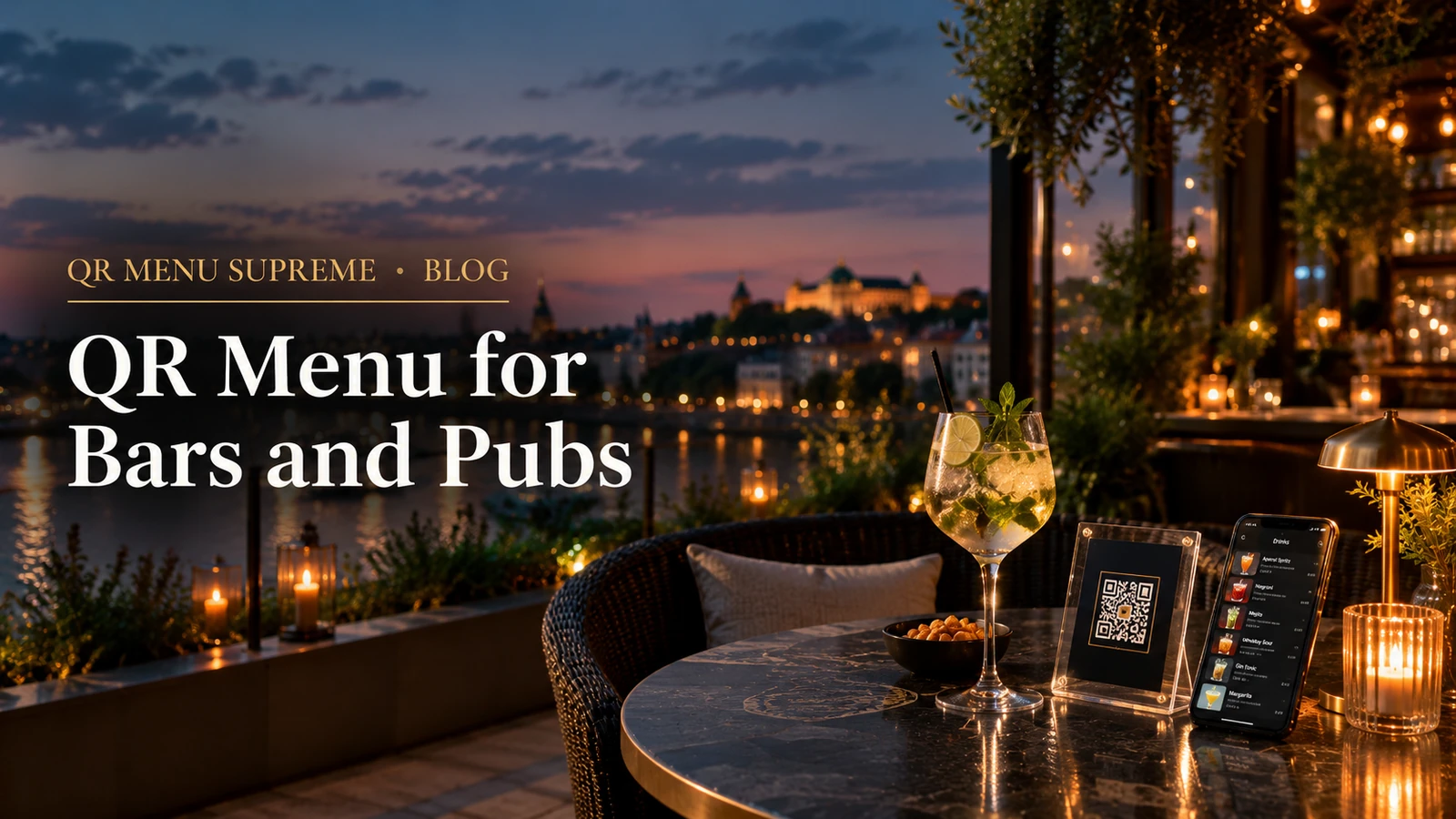
QR Menu for Bars and Pubs: Drinks, Specials, and Fast Updates
The keg is gone. The board still says it is pouring.
It is 9:12 on a Friday. Tap four died during the previous round. The bartender has already moved on. The chalkboard behind the bar has not. At the far end, a guest is reading that board through three people and a television, and is about to order the beer that is no longer there.
Ten minutes ago the early-evening price ended. The card in the holder still shows it. The cocktail list in the same holder is a PDF from March. One of those drinks uses a liqueur that ran out in July.
None of this is a rare disaster. It is a normal hour in a bar, and it produces four versions of the menu at once: the keg, the board, the card, and whatever can be heard over the room. A guest can follow any of them in good faith and still be wrong.
A café menu is read in a queue, in a few seconds, before someone reaches the till. A restaurant menu is read sitting down. A bar menu is read standing, often one-handed, in noise and poor light, and then read again two rounds later when the offer has changed. The useful digital version is the one the person on the shift can correct before the next order, and the one a guest can read without a tour of the building.
This guide is about that menu: what to list, how to show a special so it ends when it should, and how to get a kicked keg off the screen during service.
A drinks list has two speeds
Some lines change during a shift. Some should not.
The fast list is whatever is on the taps and whatever is discounted until a stated time. A keg kicks. A cask goes off. A guest ale arrives on Thursday and is gone by Sunday. Happy hour ends at 7:00, not when someone next walks past the printer.
The slow list is the back bar, the bottled beer, the wine, and the cocktails you intend to make all season. Those still need sizes, prices, and a build. They do not need to be rewritten every time tap four changes.
Putting both jobs on one chalkboard is why the board falls behind. It has room for the guest ale and almost no room for the rest. A PDF has room, then freezes. A structured menu can keep the slow list stable and let the fast list move.
Two public datasets describe the drinks, not the QR code. They also describe different rooms, so they should not be averaged.
NielsenIQ's Quality on Tap report, published with Draftline Technologies on 7 May 2026, put draft at 53.1% of US on-premise beer volume and 49.9% of beer value. The volume share was up two percentage points in two years. The universe is bars, restaurants, and other venues together. In the same release, 59% of draft drinkers said they choose it for taste and 42% for freshness over packaged beer.
A narrower cut looks different. In a Brewers Association note published on 13 May 2026, Matt Gacioch, using CGA data for US drinking places rather than the whole on-premise, put draft at 49% of beer volume in 2025. Craft beer in those places has stayed near 80% draft. Pale lager was still about 63% of volume. Low- and non-alcoholic beer volume was roughly five times the pre-pandemic level, on the Association's reading of that series.
Volume leadership across the whole on-premise is not the same claim as "most beer in every bar is draft." Value had not yet crossed half in the NIQ figures. What the two sources do agree on is enough for a menu decision. Draft is a large part of the beer a guest comes to drink, guests say they want it for taste and freshness, lager still dominates the volume, and the no- and low-alcohol line has become large enough to list properly. A tap list that is an hour out of date fails the reason people ordered draft in the first place.
The UK picture is a forecast, not a count of your street. Lumina Intelligence's UK Pub & Bar Market Report 2026, reported by the Morning Advertiser on 28 July 2026, expects the market to reach £24.7 billion this year while outlet numbers fall 0.9% to 41,171. Drink-led occasions were up 1.6%, while lunch and dinner visits weakened. Socialising was the leading reason for a visit, at 44.1%. The trading implication is plain: the drink is the visit, and a shrinking estate does not make a stale list harmless.
What the guest should see first
1. The handles, in the order they stand
Open on what is pouring. Not a photograph of the room. Not a paragraph about the brewery trip. The taps.
Match the sequence to the handles, left to right, so a guest at the tower can connect a line on the phone to a badge in front of them. For each beer include the brewery or producer, the beer name, the style, the pour size, and the price. Add ABV when you know it from the brewery, the wholesaler, or the keg collar. If you do not know it, leave it off. A guessed ABV is worse than a blank one, because the guest treats it as a fact.
When the keg kicks, that line comes off the guest menu before the next order. Hide it. Do not delete the item if the beer will come back, and do not leave it visible with a note the guest has to hunt for. The bartender who heard the tap die is the person who should make the change.
Cask needs the same honesty. If it is off, it is off the list. "Might be ready later" is a cellar fact, not a menu line.
2. The measure you actually pour
"Pint" and "shot" are not one measure across countries, or even across a city. A US pour, a UK pint, a 0.3 L glass, a 0.5 L glass, a half, and a schooner are different drinks at different prices.
Write the size you serve. If every draft beer is the same measure, say that once at the top of the section and do not repeat it on every line. If one beer is a smaller glass, say so on that line. A guest who discovers the difference at the card machine has learned it too late, and the bartender has to defend a price the menu never stated.
The same rule covers spirits. If a single is 25 ml in your house and a double is the priced drink, the menu should say so. If a call brand costs more than the well, the extra belongs next to the cocktail, not in a sentence at the bottom of the page.
3. Cocktails as builds
A good cocktail line answers three questions: what is in it, what glass it arrives in, and what it costs.
Paloma. Tequila, grapefruit soda, lime, salt. 11.
That is enough. "Our sun-drenched take on a coastal classic" is not a build, and it translates badly on a busy Saturday.
If the guest can swap the spirit, show the price consequence in the same place as the drink. Separate lines are clearer than a footnote: the house margarita, and the margarita with a named tequila at its own price. A digital menu that cannot attach options still has descriptions. Use them for the upcharge, and use the same pattern on every drink that has one.
Seasonal cocktails belong on the fast list. When the liqueur runs out, hide the drink the way you hide a kicked keg. A March PDF that still offers it in September is how regulars stop trusting the card. If that PDF is the current menu, the route out is the one in replacing a PDF with a real digital menu: break it into items you can edit one at a time.
4. Specials with an end time on the item
A special without a clock becomes an argument.
Put the end time on the item itself: "Until 7:00, then the regular price." At 7:00, either change the price or hide the offer. Leaving both prices on screen teaches regulars to ask for the cheaper one, and they are not being difficult. The menu offered it.
Some venues are not allowed to run time-limited drink discounts, or may run them only in a set form. The menu should follow the rule you already trade under. It should not invent a promotion the license does not allow.
If the software does not flip a price on a timer, name a person whose job ends at the same minute the offer does. Before service, that person sets the special. At the cutoff, that person clears it. A manager who updates "after the rush" is updating after the mistakes.
The annual cost of reprinting a list every time a price window changes is a different sum from one quiet edit. The comparison sits in how much a digital menu costs per year. For a bar, the expensive part is rarely the first print. It is the fourth correction in a month.
5. Bottles, cans, and the back bar
The board will not hold this, and it does not need to. The phone can.
Group it the way a guest asks, not as one alphabetical cellar:
- lager, pils, and pale beer in the fridge
- ale, wheat, and stout
- cider
- low-alcohol and no-alcohol
- soft drinks and mixers
- wine by the glass, then bottles
- spirits in a few real categories, not forty loose lines
Wine by the glass needs a producer or region, a pour size, and a price. "House white" is acceptable only if you also say what the house white is this week. When the last glass of one bottle is gone and the next bottle is a different wine, change the line. A glass list is a small version of a tap list.
6. Low and no, in the same type
A no-alcohol lager sits with lager, or in a clearly named section a guest can open without scrolling through the spirits. A zero cocktail sits near the cocktails. A soft drink is not a consolation prize at the end of a long page.
The low- and non-alcoholic growth figure above is a market reading, not a quota for your fridge. The menu point is simpler. People ask for these drinks in the middle of a round, often for one person in a group. If the only answer is a conversation at the well, that conversation happens at the worst moment.
Do not mark a drink "alcohol-free" unless the product in your hand says so. A low-alcohol beer and a 0.0 are different orders.
7. Allergens you can confirm
Drinks carry allergens too. Gluten in beer. Sulphites in wine, where the level has to be declared. Egg white in a sour. Dairy in a creamy cocktail. Nuts in orgeat, falernum, or some syrups. Celery salt on a rim is still celery.
The legal form depends on where you trade. In the European Union, allergen information for non-prepacked food and drink is mandatory, and each country sets how it is given. The working version of that duty for a digital menu is set out, in German, in Allergenkennzeichnung in digitalen Speisekarten. A US bar does not face one identical federal menu rule. Some states and cities have their own, and guests ask either way.
The practical standard is the same in the room. Put confirmed allergens on the item. If staff must answer orally, the notice that says so has to be visible, and the person on shift has to know the answer without guessing. A digital note does not replace a question about a severe allergy. It stops the ordinary questions from stacking up at the well.
8. Food, after the drinks
A pub that serves food still runs a bar menu first if that is why people came. Put food in its own section or its own menu, with the same sold-out rule: the kitchen hides a finished dish, the bar hides a finished keg, and neither waits for the other.
This is the point where a bar list stops resembling a café QR menu. A café is built around sizes and milk. A bar is built around what is pouring now and what the price will be in twenty minutes. The shared failure is leaving a sold-out item up because the person who knew was too busy to edit.
9. The questions that otherwise reach the well
Last orders. Whether you take cards, and any minimum. Wi-Fi. The garden. Dogs. Which screen has the match. Whether the quiz needs a team booked in advance.
None of this leads the menu. All of it saves a shout across the bar. Park it in a short section at the end.
A tourist, or a supporter in town for the match, may read that section in another language. Offer the languages you actually need, check beer styles and allergen words, and keep a manual switch. The setup is covered in multilingual QR menus. Three checked languages beat a long list nobody has read.
An order that works on a Friday
| Position | Section | Why it sits here |
|---|---|---|
| 1 | On tap now | The decision at the tower |
| 2 | This hour's specials, with the end time | Visible before the guest orders the wrong price |
| 3 | Low and no, plus soft drinks | Found during the round, not after a scroll through spirits |
| 4 | Cocktails | Builds and prices, including upcharges |
| 5 | Fridge: bottles and cans | What the board cannot hold |
| 6 | Wine by the glass, then bottles | Producer, pour size, price |
| 7 | Spirits | Short categories, not a catalogue |
| 8 | Food, if you serve it | After drinks, unless food is the visit |
| 9 | House notes | Last orders, cards, screens, garden, quiz |
During a match, the first screen matters more than the full architecture. If the guest has to pass a gallery of cocktails to find the lager, they will order from the board, including the beer that kicked at 9:12.
Who changes what
A live menu without an owner becomes the chalkboard again, only on a phone.
| Change | Who owns it | Done when |
|---|---|---|
| Keg kicks or cask goes off | Bartender on that station | Before the next order |
| Guest ale or new tap | Whoever connects it, checked by the bar lead | Before the handle is badged |
| Special starts and ends | Named person on the shift | At the clock, not after the rush |
| Cocktail build or a missing ingredient | Bar lead | Before the drink stays on the list |
| Wine by the glass changes | Whoever opens the replacement bottle | Before the first new glass is poured |
| Food sells out | Kitchen | When the last plate is sold |
| Printed backup copies | Closing or opening manager | Same taps and prices as the screen |
The test is dull and useful. Can that bartender hide one beer from the phone already in their pocket, then reopen the guest view and see it gone, in under a minute? If the edit requires a laptop in the office, it will not happen at 9:12.
On QR Menu Supreme, an unavailable item can be hidden from guests without being deleted, so the beer can return with the next keg. The guest page should be checked after the change, not only the dashboard.
How to set it up
Start from the handles, not last month's file
Walk the bar with a phone and write what is actually connected. Brewery, beer, style, size, price, ABV if it is printed on something you trust. Then the fridge, the cocktail builds you will still make this week, and the wines by the glass that are open tonight.
Last month's spreadsheet is a source of arguments. Use it only to notice what you forgot.
Pick a tool the shift can operate
The feature that matters at 9:12 is a control the bartender will actually use to mark one beer unavailable. Visual editing, a guest page that opens in the browser without an app or an account, and a free plan you can try on your own taps are the practical filters. QR menu software for small places without a tech team compares that kind of setup. The general sequence, from content to code to staff, is in how to create a QR code menu.
Ordering from the phone is a second project. It needs a code per table, a person watching the orders, and a decision about who still checks ID before alcohol is poured. A menu on a screen does not check age. If you add ordering later, the fee structure is a separate choice from the cost of displaying the list. Online ordering without platform commissions separates a platform cut from the card fee.
Most bars should get the live list right before they ask a guest to send a round from a booth.
Build the taps, then stand at the tower
Enter the draft section first. Open it on a phone at the bar, with the room lights as they are during service, brightness down, one hand occupied. If the first screen is a large photograph, the hierarchy is wrong.
Photograph a signature cocktail if the picture helps someone choose. Skip near-identical pints shot in the dark. Heavy images slow the page on a match night, when the network is busy and the guest is impatient. How to use menu photos without slowing the menu is the working standard.
Place the code where the decision happens
On the bar. A matte card near where people order. Glossy card stock under a spotlight reflects the pattern away.
By the taps, if guests serve themselves or choose while standing at the tower. Keep it high enough to stay dry, with clear space around the code.
On tables and in the garden, for the second round and for the person who cannot see the board.
One shared code is enough while the menu is display-only. Table-specific codes matter when an order has to name the table.
Print one sample. Scan it from a stool, from the garden after dark, and during a busy screen when the room is dimmer. The failures to look for are listed in QR code menu mistakes: glare, a code that is too small, a glass sitting on it, and a destination you cannot change later.
Add one line of instruction. "Scan for what's pouring" is more honest than "Scan for our menu" if the point of the page is the live list.
Keep a short printed list, and mean it
Some guests will not scan. Some cannot. Surveys of restaurant diners still show a strong preference for paper even where QR use is common. The numbers, and what they do not measure, are in Do guests actually scan QR menus?. A bar does not need a second copy of that research. It needs ten clean printed lists that match tonight's taps.
Offer one without making the guest explain. If those copies still show Thursday's guest ale, you have recreated the original problem on paper.
Brief the shift in five minutes
Staff need to know what the code opens, that the first visit can follow the phone's language when you offer that language, how to switch it, who hides a kicked keg, who kills the special at 7:00, and where the printed lists are. One sentence is enough: "The code has what's pouring now. I can also bring you a printed list."
Then run the Friday test on a quiet Tuesday. Hide a beer. Scan as a guest. Confirm it is gone. Turn it back on. If that loop is clumsy, fix it before the room is full.
Bar, café, restaurant
| Bar or pub | Café | Restaurant | |
|---|---|---|---|
| Where it is read | Standing at the bar, or back at a table in low light | In a queue or at the counter | Seated, with time |
| What changes mid-service | Kegs, cask, glass wines, timed prices | Sold-out food, milk running out | A finished dish, a daily plate |
| First screen | What is pouring, and the special's end time | Coffee, sizes, milk | The section the guest came for |
| Common dispute | A price or a beer the board still shows | A surcharge discovered at the till | A dish the kitchen cannot send |
| Who must be able to edit | The bartender on the station | The person at the counter | Whoever the pass tells |
| Code placement | Bar, taps, tables, garden | Queue, counter, tables | The table |
| Printed backup | A short current drinks list | The board, plus a few copies | A few full menus |
Before the doors open
- Scan one code with a phone that is not logged into the dashboard
- Confirm the tap order matches the handles
- Confirm yesterday's hidden beers are back only if they are pouring
- Read the special, including the time it ends, and name the person who will clear it
- Check ABV and allergen lines against the keg, bottle, or recipe, not against memory
- Open the page on mobile data as well as the bar Wi-Fi
- Look at the cards for spills, glare, and a glass sitting on the code
- Count the printed lists and throw out any that name a beer you no longer have
Repeat the scan after you change platform, domain, or printed material. A code that has lived on the bar rail for six months is the one nobody thinks to test.
Frequently asked questions
What should a bar or pub QR menu include?
The drinks that are actually pouring, with brewery or producer, style, pour size, and price. Add ABV only when you know it. Cocktails need a build and a price, including any upcharge for a different spirit. Specials need an end time. Bottles, wine by the glass, low-alcohol and no-alcohol drinks, and the allergens you can confirm belong on the item, not in a speech at the bar.
Should a QR menu replace the chalkboard or tap list?
No. The board can sell the guest ale and the drink of the night to someone standing under it. The QR menu carries the full list, the sizes, the prices after a special ends, and the drinks a guest cannot read from the back of the room. The two should match. When a keg kicks, both need to change.
How quickly should a kicked keg come off the menu?
Before the next guest orders it. The person who pulls the tap should be able to hide that line from a phone during the shift, without deleting it and without waiting for a manager in the office. The same rule applies at the minute a timed special ends.
Where should the QR code go in a bar or pub?
At the bar, where people are deciding, and on tables or in a beer garden for people who are already sitting. A matte card with a short instruction works better than a glossy one under a spotlight. Test it in the lighting you actually trade in, including during a match when the room is darker.
Do guests still need a printed drinks list?
Yes. Keep a small number of current printed lists for guests who will not scan, whose phone is dead, or who cannot get a connection. Offer one without a debate. Those copies have to show the same taps, prices, and specials as the screen.
Conclusion
A bar menu fails in a specific minute. The keg empties, the special expires, the last glass of the open wine is poured, and somewhere a guest is still reading the previous version.
The board can keep doing the job it is good at: one guest ale, one drink of the night, readable from a few feet away. The phone should carry the list the board cannot, and it should change when the bartender already knows the change. Printed copies stay for the guest who wants paper. They have to be tonight's copies.
Build the tap list first. Hide one beer. Scan it from the stool at the end of the bar. If that works in the real light of the room, the rest of the menu has a structure worth filling in.
Build a bar menu and test the code on QR Menu Supreme. Start with what is pouring tonight, mark one item unavailable, and open the guest view from the bar before you print a stack of cards.
Sources
Figures in this article are scoped to the publication named. They are not a scan rate for your room, and they are not instructions for a single tap list.
- NielsenIQ and Draftline Technologies, Quality on Tap, press release, 7 May 2026: draft at 53.1% of US on-premise beer volume and 49.9% of value; taste and freshness reasons among draft drinkers.
- Brewers Association, "A Look Inside American Drinking Places," 13 May 2026: CGA figures for US drinking places, including 2025 draft share, craft's draft share, pale lager's volume share, and the growth of low- and non-alcoholic beer.
- Morning Advertiser, 28 July 2026, on Lumina Intelligence's UK Pub & Bar Market Report 2026: market and outlet forecast, drink-led occasions, and the leading reason for a visit.
Editorial note: Prices, licenses, pour sizes, and allergen rules differ by country and sometimes by city. This article is an operating guide for a drinks menu. It is not legal advice. Check the rule you trade under before publishing a discount, an ABV, or an allergen claim.
See a live QR menu in 10 seconds
Browse the showcase demo restaurant, built with QR Menu Supreme.