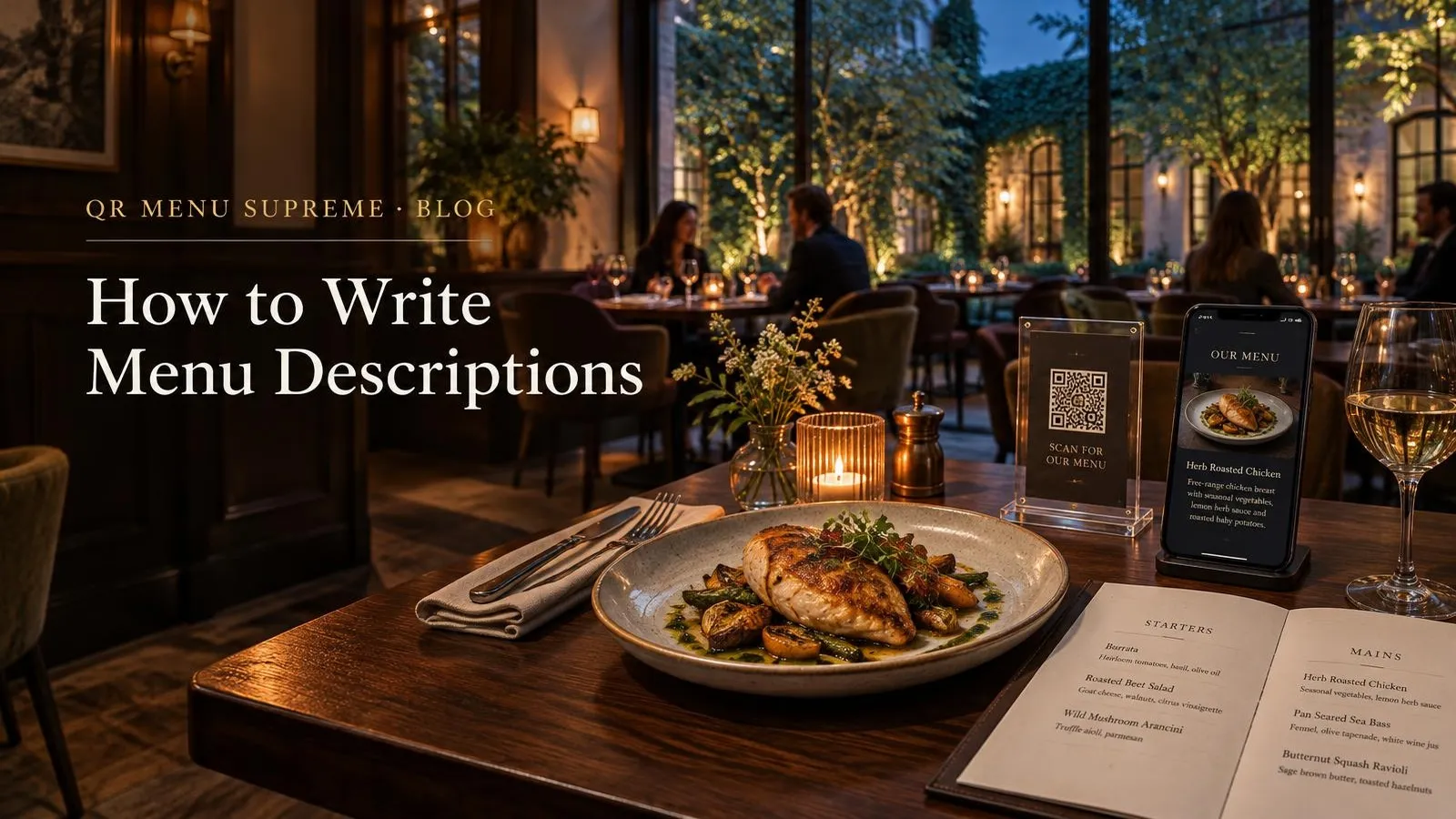
How to Write Menu Descriptions That Sell (With Examples)
The best dish on the menu sold nine times
On Monday morning, the owner prints last week's item sales from the till.
The braised short rib sold nine times. The chef thinks it is the best plate in the kitchen, and after ingredients it leaves more money than any other main course. The cheeseburger sold 63 times.
On a guest's phone, the two dishes sit a few lines apart:
Short rib. Slow cooked, seasonal garnish, jus. 26
Cheeseburger. Beef patty, cheddar, pickles, brioche bun, fries. 18
Nobody needs help with the cheeseburger. Every word in its line points at something on the plate. The short rib line asks the guest to trust three things they cannot see: what "slow cooked" means, what the "seasonal garnish" is this week, and what "jus" is. Given a dish they can picture and a dish they have to imagine, guests on a small screen are not likely to gamble 26 on the second.
Here is the same dish, rewritten:
Short rib. Beef short rib braised for six hours in red wine, until it falls apart under a fork. Mashed potatoes, glazed carrots and the braising gravy. 26
The new line is not more beautiful. It is more specific. It adds no adjective the guest has to believe. It adds a time, a liquid, a simple test (the fork) and the two things that come on the side.
This guide is about writing that kind of description. Here, a description "sells" when it helps the right guest choose a dish with confidence, at a price that makes sense to them, and then receive the dish they expected. It does not mean talking someone into a plate they will not enjoy. A description that oversells wins one order and loses the guest.
The guide covers:
- what a description has to answer,
- what research does and does not show,
- a simple formula,
- the words to use and the words to cut,
- 17 before-and-after examples from every part of the menu,
- the claims that can get a restaurant into trouble,
- how to choose which dishes to rewrite first, and
- how to check the result against your own sales.
It is written for restaurants, cafés and bars with a digital menu, but most of it works on paper too. If you are still setting up the menu itself, start with the step-by-step guide to creating a QR code menu.
The short version is simple. Lead with what the dish is. Add how it is cooked and one or two details about taste or texture. Say what comes with it. Cut vague praise, and make every claim true today. Rewrite the profitable dishes that sell too little first, change nothing else, and compare four weeks of sales before and after.
What a description has to answer
A guest scrolling a menu on a phone sees one dish at a time: the name, the price and a few lines of text. In that moment, the description has one job. It has to answer the questions that stand between the guest and a decision.
There are usually five:
| Question in the guest's head | Weak answer | Useful answer |
|---|---|---|
| What is it? | "Chef's creation" | "Pork belly" |
| How is it cooked? | "Prepared with care" | "Roasted slowly, then crisped under the grill" |
| What will it taste like? | "Full of flavor" | "Sweet and sticky, with a little chili heat" |
| What comes with it? | "Seasonal accompaniments" | "Apple slaw and steamed rice" |
| Why this one? | "Our famous dish" | "Pork from a farm 20 miles away" (if it is) |
Not every dish needs all five answers. "Espresso" answers every question in one word. A margherita pizza needs a word or two only if the dough or the oven is the point. The real work is in the dishes a guest cannot picture from the name alone. Think of house dishes, regional dishes, anything with a word like "supreme", "jus" or "nduja" in it, and anything priced above the dishes around it.
The job gets harder when guests order from their own phones. There may be no server at the table to explain the dish. The description is the explanation.
Our list of QR code menu mistakes names descriptions that "sound attractive but say nothing" as mistake number seven. This guide is the longer answer: how to write the alternative, dish by dish.
What the research shows, and what it does not
Advice about menu writing is full of confident numbers. Only a few of them hold up. These are the studies worth knowing.
Taste beats health, if the food is good
In 2016, researchers from Stanford University ran a test in a large university dining hall. Every weekday for one academic term, one vegetable dish got one of four kinds of names:
- a plain name, such as "carrots",
- a name that stressed what was missing, such as "lighter-choice beets with no added sugar",
- a name that stressed a health benefit, such as "high-antioxidant beets", or
- a name that made the dish sound enjoyable, such as "twisted citrus-glazed carrots".
The study followed nearly 28,000 diners. With the enjoyable names, 25 percent more people chose the vegetable than with the plain names. Compared with the "lighter-choice" names, the difference was 41 percent, and compared with the health-benefit names, 35 percent. The study was published in JAMA Internal Medicine in 2017.
A larger follow-up, published in Psychological Science in 2019, repeated the idea in five university dining halls across the United States: 137,842 diner decisions over 185 days, with 24 kinds of vegetables. Names focused on taste increased selection by 29 percent compared with names focused on health, and by 14 percent compared with plain names. Diners also ate more vegetables. But the effect depended on the food. The team reported that taste-focused names only worked when the dishes really were good, and a vague label such as "absolutely awesome zucchini" did not do the job.
These were dining halls, not restaurants, and the dishes were vegetables. Two lessons still carry over. First, describe what a dish is like to eat, not what it will do for the guest's body. Second, a description can only sell what the kitchen delivers.
Expensive menus name the source, cheap menus praise
Dan Jurafsky, a linguist at Stanford, worked with colleagues to study the descriptions of 650,000 dishes on 6,500 menus and wrote about the results in his 2014 book, The Language of Food. In an NPR interview that year, he summed up the pattern. Expensive restaurants, he said, are "15 times more likely to tell you where the food comes from." The cheapest places lean on "positive but vague words" such as "delicious," "tasty" and "savory." The longest menus, at middle-priced restaurants, are "stuffed with adjectives like fresh, rich, mild, crisp, tender and golden brown." Expensive menus also tend to be shorter. On why an expensive restaurant avoids words like "fresh" and "delicious," his answer was that it "implies you have to be convinced."
This is a pattern across restaurants, not an experiment. Adding a farm name will not turn a diner into a fine-dining room. What it shows is how menu language signals value. Specific facts read as confidence. Empty praise reads as a sales pitch.
Be careful with the 27 percent figure
The number quoted most often in articles about menu writing is that descriptive names lift sales by 27 percent. It comes from a 2001 study in a university faculty cafeteria, led by the food researcher Brian Wansink. In 2018, Cornell University, where Wansink later worked, announced that a faculty committee had found he committed academic misconduct, including misreporting research data. He resigned, and more than a dozen of his papers have been retracted.
We found no retraction of the 2001 paper. It is still one small study from a researcher whose work can no longer be taken on trust, and this guide does not rely on its number.
The honest summary is this: specific, taste-focused descriptions help guests choose, and they help most when the food is good. How much they help in your restaurant is something you can measure yourself. The last part of this guide shows how.
A formula that works for most dishes
Most good descriptions follow the same order:
What it is + how it is cooked + one or two details about taste or texture + what comes with it
Applied to a main course:
Lamb shoulder. Roasted slowly with garlic and rosemary until it pulls apart. Crisp roast potatoes and green beans.
Lamb shoulder is what it is. "Roasted slowly until it pulls apart" is the method and the texture. Garlic and rosemary are the taste. Potatoes and beans are what comes with it. That is 16 words after the name, and a guest can picture the plate.
A few rules make the formula easier to use:
- Lead with what the guest is choosing. If the dish is about the lamb, the lamb comes first, not the sauce.
- Use commas for familiar dishes and one short sentence for dishes that need explaining. "Burrata, roasted tomatoes, basil oil, toast" is fast to read. A regional dish may need a full sentence.
- Keep it to about 10 to 25 words. On a typical phone, that is two to four lines. QR Menu Supreme shows the whole description under the dish name and does not cut it short, so every extra line pushes the next dish further down the screen.
- Do not repeat the name. "Caesar salad. A classic Caesar salad with..." spends the first words on nothing.
- Write numbers as numbers. "Aged 28 days", "250 g", "two eggs" and "serves two" are facts a guest can use.
- Keep the unfamiliar word and explain it. "Nduja, a soft, spicy pork sausage from Calabria" keeps the real name and gives the guest a way in.
Break the formula when there is a reason. A tasting menu may list only ingredients on purpose, because the guest has already decided to trust the kitchen. A drinks list follows its own rules: producer, region, size and strength. And a dish whose name says everything does not need a sentence to repeat it.
Words that earn their place
Some words do real work in a description. Use them when they are true.
Cooking methods that change the taste. Charred, braised, smoked, roasted, grilled, fried, cured, pickled, wood-fired. "Grilled" tells the guest something "cooked" does not. "Slow cooked" means more with a time attached.
Texture, one word at most. Crisp, crunchy, creamy, silky, flaky, chewy, soft. Texture is often what a guest is really choosing between.
Flavor direction. Smoky, sharp, sweet, sour, salty, bitter, herby, peppery, spicy. For heat, say how hot: mild, medium or hot, or "a slow chili heat".
Specific ingredients instead of categories. "Brown butter and capers" instead of "a rich sauce". "Kale and chard" instead of "seasonal greens". A digital menu can be edited in a minute, so there is no need to hide behind "seasonal" when the vegetables change. Change the line.
Where it comes from, when it is true and means something. A farm, a fishing port, a cheesemaker, a region. "Cheddar" is a fact. "Cheddar aged 18 months on a farm in Somerset" is a reason. A source the guest cannot place adds little. A source that explains the taste or the price earns its place.
Proof of effort. "Made here every morning", "dough rested for 48 hours", "braised for six hours". Numbers and routines are easy to believe in a way that "made with love" is not.
Words to cut
| Cut | Why | Write instead |
|---|---|---|
| Delicious, tasty, yummy, mouth-watering | Praise the guest cannot check, and in Jurafsky's research a mark of cheaper menus | The actual taste: smoky, sharp, sweet, buttery |
| Cooked to perfection | Every dish should be. It says nothing | How it is cooked: "pink in the middle", "seared, then roasted" |
| Bursting with flavor | Which flavor? | Name it: "garlic, lemon and chili" |
| Succulent, tender (on everything) | Worn out by overuse | The method that makes it tender: "braised for four hours" |
| Fresh (on every dish) | Guests expect it, so on its own it says little | Say what is fresh when it matters: "fish delivered this morning" |
| World-famous, legendary, best in town | A claim no guest can check | Proof: "on the menu since 1998" |
| Signature (on six dishes) | If everything is special, nothing is | One or two dishes, marked once |
| Made with love, Grandma's favorite | Warm, but empty | The real detail: "my grandmother's recipe from Puglia, with fennel seeds" |
| Jus, beurre blanc, gochujang (alone) | Many guests do not know them | Keep the word, add a few more: "gochujang (Korean chili paste)" |
| CAPITAL LETTERS and !!! | Shouting reads as a sales pitch | Calm, specific text |
Before and after: examples from every part of the menu
Each example below shows a typical line, a rewrite and the reason the rewrite works. The dishes and prices are illustrative. Use the method, not the details: never copy a fact that is not true in your kitchen.
Starters
Soup of the day
Before: Soup of the day. Ask your server.
After: Today's soup: roasted red pepper and tomato, with sourdough and salted butter. 7
Why it works: A digital menu can say what today's soup is. Update it before service, and "What's the soup?" stops being the first question at every table.
Calamari
Before: Calamari. Fried squid with dip. 11
After: Calamari. Squid in a light batter, fried to order so it stays crisp. Lemon and garlic mayonnaise. 11
Why it works: "Fried to order" explains the texture the guest is paying for. The dip has a name.
Salads
Before: Healthy green salad. Low in calories and packed with vitamins. 12
After: Little gem lettuce, cucumber, avocado and toasted pumpkin seeds, with a sharp lime and chili dressing. 12
Why it works: This is the Stanford finding in one line. The first version sells the salad as a duty. The second sells it as something to enjoy, and a guest who wants a light dish still recognizes it.
Main courses
Chicken
Before: Chicken Supreme. Delicious chicken breast cooked to perfection. 22
After: Chicken supreme, the breast roasted on the bone so it stays juicy. Wild mushroom sauce, mashed potatoes. 22
Why it works: "Supreme" is a kitchen term for a chicken breast with the wing bone still attached, and many guests will not know it. The rewrite keeps the name, explains it in passing, and replaces "delicious" and "perfection" with a method and its result.
Fish
Before: Pan-fried hake, seasonal vegetables, sauce. 24
After: Hake, pan-fried with crisp skin, in brown butter with capers and lemon. Crushed new potatoes and green beans. 24
Why it works: "Seasonal vegetables" and "sauce" are blanks the guest has to fill in. The rewrite fills them.
Steak
Before: Sirloin steak. Served with fries and peppercorn sauce. 29
After: Sirloin steak, 250 g (about 9 oz), aged 28 days and grilled over charcoal. Cooked medium-rare unless you ask otherwise. Fries and peppercorn sauce. 29
Why it works: Weight, aging and the default cooking level answer three questions guests often ask about steak, before they ask them.
Vegetarian and vegan dishes
Before: Vegan Buddha bowl. A healthy plant-based option. 16
After: Roasted sweet potato, crispy chickpeas, kale and brown rice, with a tahini and lemon dressing. 16 (with the Vegan icon)
Why it works: The icon tells guests the dish is vegan. The text tells everyone at the table why they might want it. Written as food rather than as a dietary option, the dish is easier to choose for anyone.
Pasta, pizza and regional dishes
Before: Spaghetti alla Norma. 15
After: Spaghetti alla Norma: fried eggplant, tomato and basil, finished with grated salted ricotta. 15
Why it works: The Sicilian name stays, because it is part of what the guest is buying. A dozen words tell them what it is.
Burgers, sandwiches and casual food
Before: THE MONSTER!!! Can you finish it? 19
After: The Monster. Two beef patties, smoked cheddar, bacon and pickled onions in a brioche bun. Fries on the side. 19
Why it works: A playful name is fine. The description is where the joke stops and the facts start. Guests can now judge the size for themselves.
Kids' menu
Before: Kids' meal. 8
After: Small chicken schnitzel with fries and cucumber sticks. Comes with juice or water. 8
Why it works: Parents choose fast, often while doing three other things. They need to know what arrives and what is included.
Desserts
Before: Death by chocolate. Indulgent and decadent. 9
After: Warm chocolate fondant with a soft middle and vanilla ice cream. It takes 12 minutes, so order it with your main course. 9
Why it works: "Indulgent" tells the guest how to feel. "Warm" and "soft middle" tell them what to expect. The timing note is honest, and it moves the dessert decision to a moment when the guest is still hungry.
Coffee and café items
Before: Filter coffee. 4
After: Filter coffee. This week's beans: a washed coffee from Huila, Colombia, with notes of red apple and caramel. 4
Why it works: Specialty coffee drinkers choose by origin and taste, and a digital menu can change the line when the bag changes. For the rest of a café menu, use the names guests say at the counter. Our guide to QR menus for cafés covers drinks, sizes and milk options.
Cocktails
Before: Summer Breeze. A refreshing tropical delight! 12
After: Summer Breeze. White rum, pineapple, lime and mint, shaken and served long. Sharp and not too sweet. 12
Why it works: Many guests choose a cocktail by its base spirit and how sweet it is. "Not too sweet" answers the question they would otherwise ask at the bar. There is more on writing drinks lists in our guide to QR menus for bars and pubs.
Wine by the glass
Before: House red. 8
After: House red: Montepulciano d'Abruzzo, Italy. Soft and fruity, not heavy. Good with the pizzas and the lamb. 150 ml glass. 8
Why it works: A guest who knows wine sees the grape and the region. A guest who does not gets three plain taste words and a suggestion. The pairing line is an honest way to sell a second item: it helps, and it is easy to ignore.
Non-alcoholic drinks
Before: Soft drinks. 4
After: House lemonade, made here every morning with lemons and a little honey. Still or sparkling. 5
Why it works: "Made here every morning" is a reason to choose it over a can, as long as it is true.
Specials
Before: Ask about today's specials!
After: Today only: whole grilled sea bream with salsa verde and new potatoes. 26. Until it runs out.
Why it works: A special that guests have to ask about is easy to miss. A digital menu can show it with an honest limit and hide it when the last portion goes.
Sides and add-ons
Before: Sides available on request.
After: Garlic and rosemary roast potatoes. 5 (listed as its own item, with "Good with the garlic roast potatoes" in the steak description)
Why it works: A side that exists only "on request" is hard to order. Listed as its own item, it becomes easy to add. Keep pairing suggestions rare: one or two on the whole menu, where they are true, are enough.
Honest words sell longer
A description is a promise the kitchen has to keep at every service. Some words are also claims with legal weight.
Claims guests can check. Homemade, house-made, fresh, local, organic, free-range, wild, hand-made. Use them only when they are true today, for that dish. If the dessert called homemade arrives from a supplier, guests may notice, and your staff will have to defend the line.
The law where you trade. In the European Union, food information must not mislead, for example about what a food is, what it contains, where it comes from or how it was made. That rule is in Article 7 of Regulation (EU) No 1169/2011, and it covers food served in restaurants as well as packaged food. The United Kingdom kept the same rule in its own version of the regulation. Other countries have their own food and consumer rules, so check what applies where you trade.
Protected names. Some product names are protected by law and tied to a place and a method. In the EU, names such as Champagne, Parmigiano Reggiano and Prosciutto di Parma are protected in this way. If the bottle or the cheese is not the real product, call it what it is: sparkling wine, hard cheese, cured ham.
Diet claims. "Gluten-free" is not a style choice. In the EU and the UK, it is reserved for food that contains no more than 20 milligrams of gluten per kilogram as sold to the consumer. A dish fried in oil shared with battered fish may not meet that, whatever its ingredients. "Vegan" and "vegetarian" describe diets. They are not allergen information. Our guide to allergen labeling on a digital menu explains how to keep diet labels, allergens and shared-equipment risks apart.
Icons are claims too. QR Menu Supreme lets you add one or more icons to a dish, such as Chef's Pick, Popular, Spicy, Vegan, Vegetarian, Gluten-Free, Organic or Healthy. An icon makes the same promise as the word. Words such as organic and healthy have rules of their own in many countries, so check them before you use them. And if six dishes in a category say Popular, none of them stands out.
The photo has to agree with the text. If the photo shows a side the description does not mention, the guest will expect it on the plate. Our guide to menu photos explains how to keep images honest and fast.
Choose which dishes to rewrite first
Rewriting the whole menu at once makes it impossible to tell what worked. Start with a few dishes, and choose them with numbers.
In 1982, Michael Kasavana and Donald Smith published a method called menu engineering. It sorts every dish by two numbers: how often it sells, and how much money it leaves after the cost of its ingredients. That second number is called the contribution margin. Together, the two numbers put each dish into one of four groups:
| Group | Sells often? | Good margin? | What to do with the description |
|---|---|---|---|
| Stars | Yes | Yes | Leave it alone, or tidy it |
| Plowhorses | Yes | No | Usually leave it; look at price and portion cost instead |
| Puzzles | No | Yes | Rewrite these first |
| Dogs | No | No | Ask whether the dish should stay at all |
The short rib from the opening is a classic puzzle. The kitchen is proud of it, it makes money, and guests pass it by. Puzzles are where a better description can matter most, because the dish is already worth selling. A description cannot rescue a dish that guests try and do not like. That is a recipe problem, not a writing problem.
To find your puzzles, you need two things: four weeks of item sales from your till, and the ingredient cost of one portion of each dish. Subtract the ingredient cost from the price to get each dish's margin. Then look for dishes whose margin is above the average for their category and whose sales are below it. Pick three to five.
Test the rewrite on your own sales
QR Menu Supreme's menu analytics count menu views and QR scans. They do not show which dish a guest chose, so for most restaurants the test runs on the till. If guests order at the table through QR Menu Supreme's Max plan, the Max analytics also list the top items. They show quantity and revenue for today, the last 7 or 30 days, or a custom range. Our guide to commission-free table ordering explains how ordering from the menu works.
A simple, fair test:
- Write down the "before" numbers. For each chosen dish, note how many were sold in the last four weeks and how many dishes were sold in its category.
- Change only the description. Keep the price, the position in the category and the photo exactly as they were. If you change three things, you will not know which one worked.
- Run it for four weeks. Do not compare a holiday month with a normal one. If your trade is seasonal, compare with the same weeks last year.
- Compare the share, not the count. If the short rib sold 9 of 120 mains before and 15 of 118 after, its share rose from 7.5 to 12.7 percent. Using the share keeps a quiet week from hiding a real change, or a busy week from inventing one.
- Ask the team. Which questions about the dish stopped? Did new ones start? Did anyone send it back because it was not what the menu said?
- Keep what works and undo what does not. Then move on to the next few dishes.
A digital menu makes this cheap. A rewrite takes a minute and costs no reprint. It also makes it tempting to change something every week. Wait until the test is finished.
Write for the phone, the search box and other languages
On a digital menu, a description does more than sit under the name. In QR Menu Supreme, it also feeds the search, the translations and the length of the page.
The whole description is shown. It is not cut short, so a long description pushes the next dish down. Save the long ones for the dishes that need them.
Guests can search it. When menu search is turned on (Starter plan and above), it looks through dish names, descriptions and categories, both in the guest's language and in the original. A guest who types "salmon" finds every dish that mentions salmon. A dish described only as "the chef's catch of the day" will not appear when a guest searches for cod.
It is translated automatically. On the Starter plan and above, guests can read the menu in the languages you choose, and the descriptions are translated for them. Concrete ingredients translate cleanly. Puns, idioms and in-jokes often do not, so a dish called "Hangover Cure" needs a description that says what is on the plate. Our guide to a multilingual menu without managing translations explains which words to check.
Allergens belong in their own fields. QR Menu Supreme stores the 14 allergen groups as separate fields on each dish, so guests see them in the same place every time and the allergen filter can use them. Keep allergens out of the prose, except for details the fields cannot hold, such as the specific nut.
Icons are a shortcut, not a substitute. Use a few, the same way across the menu. A Spicy icon next to "a slow chili heat" tells the guest more than either one alone.
Imported text is a first draft. If you import an existing menu from a PDF or a photo, the descriptions come from the menu you had on paper. Rewrite them before the QR codes go on the tables. Our guide to replacing a PDF menu covers the import itself.
Photos are optional, descriptions are not. A good photo helps a guest recognize a dish. It cannot tell them what is in the sauce.
Checklist before you publish
Each description
- Starts with what the dish is
- Says how it is cooked, if that changes the taste
- Gives one or two specific details about taste or texture
- Says what comes with it
- Explains any word a guest may not know
- Contains no vague praise, such as delicious or cooked to perfection
- Makes no claim that is not true today
- Stays under about 25 words, unless the dish needs explaining
The menu as a whole
- No more than one or two dishes per category are marked Chef's Pick or Popular
- Allergens are in the allergen fields, not only in the text
- Photos and descriptions show the same dish
- Changing sides and garnishes are named and updated, not called "seasonal"
- Protected names and diet words appear only where they apply
The test
- Three to five puzzle dishes were chosen from sales and cost data
- Price, position and photo stayed the same during the test
- Four weeks before and after were compared as a share of the category
- The team was asked which questions changed
Frequently asked questions
How long should a menu description be?
Usually 10 to 25 words, which is two to four lines on a typical phone. That is enough to say what the dish is, how it is cooked, one or two details about taste or texture, and what comes with it. Write more only for the few dishes that need explaining, such as a regional dish or a special.
Do menu descriptions really increase sales?
They can, but the evidence is narrower than many articles suggest. In Stanford studies in university dining halls, vegetables with taste-focused names were chosen more often than the same vegetables with health-focused or plain names. The effect depended on the food being good. The widely quoted 27 percent figure comes from a 2001 study led by a researcher who was later found to have committed academic misconduct. The reliable test is your own sales before and after a rewrite.
Which words should I avoid in menu descriptions?
Vague praise such as delicious, tasty and mouth-watering, phrases such as cooked to perfection and bursting with flavor, and claims a guest cannot check, such as world-famous. Also avoid any word that is not true today, such as homemade, fresh, local or organic. Name the taste, the cooking method and the ingredients instead.
Does every dish need a description?
No. A dish whose name says everything, such as an espresso or a margherita pizza, needs little or nothing. Descriptions matter most for dishes guests do not know, dishes priced above the ones around them, and profitable dishes that sell less than they should.
Can I use AI to write menu descriptions?
As a first draft, yes. An AI tool does not know your recipe, your suppliers or what changed this week, and it tends to produce exactly the vague words that should be cut. Check every ingredient, method and claim with the kitchen before you publish.
Should allergens go in the description?
Put allergens in the allergen fields, so guests find them in the same place for every dish and an allergen filter can use them. Use the description only for details the fields cannot hold, such as the specific nut or cereal, and keep it in line with the verified recipe.
Conclusion
The short rib rewrite added no adjectives. It added six hours, red wine, a fork and two named sides. That is most of what good menu writing is: replacing words a guest has to believe with facts a guest can picture.
Start small. Pick three to five dishes that make money and sell too little. Rewrite each one with the formula: what it is, how it is cooked, one or two details about taste or texture, and what comes with it. Read every claim back to the chef. Change nothing else, wait four weeks, and let the till tell you what worked.
Build your menu and read it on a phone with QR Menu Supreme. Upload the menu you have now or enter five dishes by hand, rewrite their descriptions with the formula, and scan the result from a table before you change the rest. The free plan includes up to 20 items, and no credit card is required.
Sources and editorial note
- Turnwald, B. P., Boles, D. Z., and Crum, A. J. (2017). Association Between Indulgent Descriptions and Vegetable Consumption: Twisted Carrots and Dynamite Beets. JAMA Internal Medicine.
- Turnwald, B. P., and colleagues (2019). Increasing Vegetable Intake by Emphasizing Tasty and Enjoyable Attributes: A Randomized Controlled Multisite Intervention for Taste-Focused Labeling. Psychological Science.
- Jurafsky, D. (2014). The Language of Food: A Linguist Reads the Menu. W. W. Norton.
- NPR, All Things Considered, September 15, 2014: 'Language Of Food' Reveals Mysteries Of Menu Words And Ketchup.
- Wansink, B., Painter, J., and van Ittersum, K. (2001). Descriptive menu labels' effect on sales. Cornell Hotel and Restaurant Administration Quarterly.
- Statement of Cornell University Provost Michael I. Kotlikoff, September 20, 2018.
- Kasavana, M. L., and Smith, D. (1982). Menu Engineering.
- Regulation (EU) No 1169/2011, consolidated text, Article 7, and the UK version of Article 7.
- Commission Implementing Regulation (EU) No 828/2014 on information about the absence or reduced presence of gluten in food.
- Regulation (EU) 2024/1143 on geographical indications.
Editorial note: Source review date: October 19, 2026. This article is an operating guide to menu writing, not legal advice. The restaurant in the opening is an example, not a report on a real business. Dish examples and prices are illustrative and shown without a currency. Product features reflect QR Menu Supreme on the review date and may change. Check the food-information rules where your restaurant trades before using claims such as gluten-free, organic or a protected product name.
See a live QR menu in 10 seconds
Browse the showcase demo restaurant, built with QR Menu Supreme.